Across the country, or even statewide, we don’t currently have a formal process for teaching our kids about their finances, but we should absolutely be teaching our kids about their finances. There are lots of different ways it can be done, but the important part is that kids grow up with an understanding of spending only what you have, contributing to savings and that one day, they will have bills to pay. When we instill ideas in our kids from an early age, we help ensure they are prepared when that first credit card offer comes in the mail, and when they go out on their own and have to pay rent and utilities. How you go about teaching your kids is up to you.
Lots of people don’t want to share their personal financial situation with their children, and I personally think that’s totally fine. There are lots of ways you can focus on teaching money management for children without sharing your own details. Here are a few examples that I have encountered among my friends and family.
1. Decide on a Savings Plan
Pick a percentage you think is reasonable, and let your kids know that a percentage of any birthday checks they receive or babysitting money they earn will go into savings and explain to them that this is a habit they want to have for the rest of their lives. People I know who have done this chose a percentage higher than what you would probably save in the real world, in an effort to set their kids up to have a good amount in savings by the time they enter the real world. The exact amount you choose is up to you, but I like this idea because it gets kids thinking about saving and starts the habit of not spending everything you earn early on.
Other friends of mine have let their kids spend any cash they receive, but any checks go into savings. For birthdays and things, often checks will be larger than cash amounts given, so this can be a good plan for building your child’s savings account, but is less translatable to the real world. If you choose this plan, I would use it in conjunction with other methods of teaching your kids about personal finance.
2. Mandate a Savings Account Minimum Balance
As your kids get older, the toys and things they want seem to increase in price. For those items they really want and are willing to spend their own money on, come up with a savings plan for them. Allow them to spend what they want as long as their savings account has a certain amount in it. Or make the savings account they normally contribute to like the adult version of a retirement account, and explain that they can’t just empty it when they want a new toy. Instead, they’ve got to save up by not spending their future income and put that money away separately towards a certain goal.
3. Turn their allowance into a real world income
This is the most complicated one, but perhaps the one that would teach them the most about how the world of personal finance really works. Each week they receive an allowance for chores completed, which effectively equates to their paycheck. Once a month, they have to pay some of that back to you for various expenses, which would represent, rent, utilities, groceries, etc… If you choose to go this route, you will want to make sure their allowance is enough that they can pay you a portion back and still have some left for spending, and of course the amount they would pay you back would simply be so they get the idea, not necessarily a real world portion.
How you choose to teach your kids about personal finance depends on how much effort you can and want to put into it, but the important part is that it is something that is talked about. Whatever method you use, take the opportunity to explain to your kids how things will work when they go out on their own and help them set up good habits now that will serve them well later on. Hopefully these ideas have gotten your creative juices flowing.
They are four years old one day and 34 the next. And we don’t mean that time flies. We mean teenagers are all over the map in terms of their maturity.
Once they get past age 12, they are adults in training. As the grown-up of the house, it’s your job to teach them what they need to know so they can survive on their own when it’s time to move out. If you don’t prepare them for that, then don’t make plans to remodel their bedroom. They’ll still need it.
You are the parent, so act like it. Sit down with your kids one by one and show them how to make a budget. Find out what they spend their money on and work out a plan with them. Don’t make it for them. Let them give mature input. Let them know that this budget is theirs. If something is out of whack, you can correct it, but you’re not babying them. You are letting them set their own priorities. Make sure that they know that.
Teach them about having long-term savings goals. At this age, their own car is probably the first thing on their minds. If they want one, they can pay for it. Both of you should put down in the budget what they should save each month, and for how long, before they have enough to pay cash for a ride. Early exposure to goal setting helps to give them patience and vision, two things they’ll need in life.
This should be a given, but no credit cards! A teen with a credit card is only slightly less dangerous than one with a loaded gun. Don’t fill their brains with that “you need a card to build your credit” crap. That’s for people who want to make a life habit of borrowing money. Break that cycle before it even gets started by teaching them to not borrow.
The great thing about providing financial education for kids is that the feeling of responsibility spills over into other areas of life. Money is important to a teenager, so someone who is careful with how much they spend won’t carelessly hang out with the wrong crowd or be foolish about not making grades in school. That sense of accountability will permeate their lives and help them behave.
It’s all right if your kids don’t think you’re cool because you are on their case about money. A parent who is most concerned about being liked by their kids isn’t a parent. He or she is more like a jellyfish. Neither has a backbone.
Love your kids enough to properly teach them about being adults. If they are deeply in debt with a marriage hanging by a thread in 30 years, what are you going to say? “Sorry, son, that I didn’t teach you better … but at least you thought I was cool when you were a teen!”
Teaching Teens About Money! If there’s one huge gift we as parents can give our kids, it’s the knowledge they need to grow up to be financially stable adults.
As National Teach Your Child to Save Day rolls around this month (April 20), now is the perfect time to start teaching best practices for savings. And with the graduating class of 2018 about to walk the stage, it’s urgent that parents make sure their teens have the information they need to manage their money.
But before you can expect kids to happily embrace the idea of setting money aside, they might need your help understanding a few things to make it all click, including:
While you may have encouraged your kids to save money for big purchases, many teens still don’t understand all the “whys” behind saving. They’ve never had to pay for things such as unexpected car repairs or monthly expenses like a utility bill.
TRY THIS: If your teen isn’t working or doing chores already, get him or her started right away — and begin paying for some personal expenses, such as gas and weekend entertainment. Work together to create a budget of monthly income and anticipated expenditures to help create a clear picture of “money in” and “money out.” If your child is headed off to college, discuss which living expenses he or she will be expected to cover and how to accomplish that.
Before teens can truly master money matters, they should understand how money moves around. They need a solid rundown on the basics, from checking and savings accounts to bank fees, to how debit cards work and what it means to “bounce” a check.
TRY THIS: Start off by opening a “checkless” checking account for your teen. One of the biggest bonuses of these types of accounts is that you can’t overdraft, which is good news when your child is still learning the financial ropes. Axiom Bank’s AxiomGO checkless checking app also lets you safely transfer money to your child’s account without visiting a bank branch, track expenditures, set up budget categories and more.
It doesn’t mean splurging on a shopping spree or an expensive restaurant. “Paying yourself first” is the financial concept of automatically routing money into a savings account before allotting funds for other expenses. Regular, consistent contributions are key to building short-term savings (new car, vacation, etc.) as well as a rainy-day fund and a “nest egg” for the future.
TRY THIS: Help your teen open both short-term and long-term savings accounts. If he or she has a steady paycheck, sign up for direct deposit and then schedule automatic payday transfers from checking into each savings account. My $ Manager, AxiomGO integrated budgeting tool, lets you create a budget and set savings goals and spending limits.
It’s vital that teens understand how borrowing money works, especially since they’re on the cusp of becoming credit-holders themselves. Building a credit history is important for financial success in adulthood. But with 4 out of 5 Americans in debt, your child needs to be aware of the potential pitfalls of credit. Help them understand that racking up too much debt or making late payments can result in huge interest payments and late fees that will damage their credit score — as well as their ability to borrow money in the future.
TRY THIS: This Credit Card Simulator game helps teach teens what to look for when applying for a credit card, such as Annual Percentage Rate (and “introductory” APR) and annual fees. It also demonstrates how interest kicks in when you only pay the monthly minimum. And this credit calculator provides a visualization of how people with lower credit scores pay more in interest when they borrow money for big purchases such as houses and cars.
Your kids may not realize that “smart” saving is more than just sticking cash in a jar on a shelf. That’s why you must explain the idea of compound interest to them: When you save, you earn money on the funds you’ve stashed away. Just don’t forget to stress that the reverse is also true: When you borrow money, you pay money on the money you’ve been loaned.
TRY THIS: Use an online calculator to show how money saved will grow exponentially with various interest rates. One way to make the idea of interest more real to teens is for you to make contributions to their savings as they reach their goals.
One of the most important jobs we have as parents is to teach our children how to navigate the adult world. An important skill they’ll need to master is managing their money.
Starting while they’re young is a good plan but if you’ve missed that boat it’s not too late.
So how can we successfully teach our kids to manage money when they’re teenagers, still living at home, and dependent upon us for most of their monetary needs?
Some school districts, realizing the importance of educating young people about money, have begun offering personal finance classes in high school.
North Carolina recently became the twentieth state to require high schoolers to complete a course in economics and personal finance to graduate.
Topics taught to teens include paying for college, using credit cards, and taking out a home mortgage.
Even if your state doesn’t require such a course in high school, however, there are ways you can teach your teenager how to manage their finances.
Teaching Your Teen About Money
Here are six essential money topics and tools to discuss and use with your teen to boost their financial literacy.
Bonus Reading: How Can You Make Managing Your Money More Fun?
Budgeting
One of the fundamentals in personal finance is “spending less than you earn.” Since teenagers don’t usually have full-time jobs, and may not earn any money at all, how can we teach them how to manage their spending?
One way is to allow them to make all of their purchases out of a weekly or monthly allowance. That way, they’re forced to budget for the things they need and want.
You can ask them to pay for clothing, school lunches, car insurance, and gas (If they’re drivers), school supplies, and entertainment money. They’ll have to decide how much to spend in each financial category.
They’ll also need to make sure they don’t spend too much cash in one category and run out of money for another.
If you feel comfortable, share your budget with your teen. Be sure to go over all of the periodic or hidden expenses also included in the family budget.
You can explain the difference between gross and net pay. Plus, show them how much money comes out of your wages for taxes, health insurance, and retirement saving.
With teens, showing often works better than telling. So, giving your child space to make his own financial decisions or showing him your budget will be a more powerful teaching tool than hypothetical advice.
Allowance Cards
How do you give your child her allowance each week? Cash can be a pain to deal with nowadays.
You may consider opening a bank account for your teen and getting her a debit card so you can deposit her allowance directly into her account.
(Note: Most banks require a photo ID, so if your teenager doesn’t have a driver’s license, you may need their birth certificate, Social Security card, or a photo ID from the DMV.)
You can also use services like FamZoo or Greenlight.
FamZoo offers a private online family “banking” system designed to help you teach your kids good money habits. You as the “banker” manage your kids-the “customers” funds through IOU accounts or prepaid cards.
FamZoo will cost you between $2.50 – $5.99 per month for your entire family depending on whether you subscribe monthly or pay in advance.
Greenlight is a debit-card service for kids that allows you to open a debit card for your children without a bank, as well as monitor their spending and okay spending at specific stores. The service costs $5 per month for up to five children.
How much allowance to give them?
If they’re covering all of their spendings, they may need more than the national average (currently $30 per week, according to a poll by the American Institute of CPAs).
You can try a dollar amount that fits your family budget, and if you find it’s too low or too high, then adjust accordingly.
Consider requiring your teen to save and invest a portion of their allowance also, to make those money habits automatic.
Additionally, this can be a great time to remind your teen about setting aside some funds to donate to their favorite causes.
Let Them Fail
Teenagers tend to take bigger risks than adults because the area of the brain that controls self-regulation is still in development. So is it a wise idea to let them take risks with money?
The key is allowing them to fail with money in a lower-stakes setting so that they can learn how to budget before they have to pay for their own apartment, utilities, and food.
This method allows your teen to make decisions about spending with real-world consequences, while still in a safe environment. This will only work, though, if you’re willing to let your child face the consequences of his spending.
Did he run out of money for gas this week? Instead of giving him more, let him figure out how else to get to school. Maybe he’ll need to catch a ride with you or ask a friend to come pick him up.
Resist the urge to fix budgeting problems and he’ll quickly learn to make his money last, rather than repeat the discomfort of running out of money.
Borrowing Money
Credit card companies will likely send your teen information about credit cards as soon as she turns 18.
Companies are all over college campuses, encouraging college students to apply for cards. If your teenager doesn’t know how to manage credit, though, she could get into some big trouble with a credit card.
Research has shown that teens are more likely to think using their limbic systems and make decisions based on feelings. The same research shows that unfortunately, those decisions are often faulty.
Plus, your teen has had less experience managing money and thus is more likely to make poor decisions. So a credit card could be a dangerous tool in the hands of your teen.
Since your example is often the most powerful to your child (even if it doesn’t seem like it), talk to your teen about the pros and cons of credit cards and loans.
If you use credit cards, explain the power of paying them off in full each month, and using them very carefully. Explain the interest charges and penalties of not paying off your credit card each month, and how paying your card off each month helps you build good credit.
If you’ve given her a bank account and she’s used to spending with a debit card, then a credit card will be less tempting, especially if she’s made a few budgeting mistakes along the way. But with proper discipline, a credit card can be a useful tool for your college student.
Investing
One of the most abstract personal finance concepts for teenagers is investing. It can be hard for many teenagers to wrap their minds around the idea that saving money now can benefit them in three or more decades.
As a parent, have honest conversations with your teen about investing. If investing a portion of his income becomes a habit now, then he’ll likely continue to invest as he grows older.
You can show him charts that demonstrate the power of compound interest. Explain how money invested is at risk, but that some risk is necessary.
Encourage him to set up an IRA in his teenage years, or set one up for him (see below for more information).
An added benefit to talking about investing is that it helps your child think beyond immediate goals, like saving for a car, and helps them develop longer-term financial planning skills.
The word “millionaire” is powerful to a teenager, so show him how he can become a millionaire by saving small amounts of money early and giving it lots of time to compound.
One example: if your teen saves $5,000 per year, starting at age 18, for ten years ($50,000 total) and allows that money to grow, with an average 7% return, until he’s 65 years old, he’ll have over $1,000,000.
Jobs
There are several advantages to teens having a job. First, it teaches responsibility, and how hard she has to work to earn a dollar. Second, it allows your child to open an IRA with her earnings.
If your child has a W-2 or 1099 job (in other words, earned income that she has to file an income tax report on), she is eligible to save in her IRA. She can save 100% of her earnings, up to $6,000 per year, in an IRA.
As a parent, you can “match” her earnings, and put money in on her behalf, up to $6,000 per year, as long as it’s less than any earned income.
You can help your teenager find a traditional job, or encourage her entrepreneurial spirit, by helping her think through opening a dog-walking or babysitting business. That income, if reported to the IRS, can allow her to start an IRA as well.
Teaching Teens Financial Topics
Even if you don’t feel 100% confident in your own personal finance skills, start conversations with your teenager about money.
Your child doesn’t expect you to be perfect, and talking through your own money mistakes can be powerful lessons for your child.
Check out some personal finance books from the library or order from your favorite bookseller. Then read and discuss them together.
The lessons you focus on money management for children now are laying the groundwork for a lifetime of positive earning, saving, and investing behavior.
From starting a piggy bank to sending your kid off to college with a credit card, helping kids learn healthy habits around money can take a lot of work — and patience.
But teaching teens about money early on will help them cope with challenges like setting limits, planning a budget and resisting impulse buys. There are a lot of different ways to help kids get smart about spending, but we’ve put together some basics to help parents get started.
Start young
Although it’s never too late to develop good money habits, starting the conversation when children are young will make things easier down the line when the stakes are higher. Dr. David Anderson, senior director of the ADHD and Behavior Disorders Center at the Child Mind Institute, suggests beginning to talk about money when your child is in second or third grade. “That’s when most kids’ math skills get to the point where they’re able to understand this kind of arithmetic.”
Talk about money
Talking comfortably about finances is an important part of helping kids developing a healthy relationship with money. “Talking about money can’t be relegated to a one-time conversation,” advises Lynne Somerman, a money coach and founder of The Wiser Miser. “It needs to be part of the day-in, day-out conversation. As money topics come up and your kids are around, talk about them as openly as you feel comfortable.”
One way to do this is by including your children in basic financial decisions. For example, at the supermarket you can look at the circular together to see what’s on sale before deciding what to make for dinner. Or you can ask them to make budget-based decisions, like they can have one pair of more expensive shoes or two pairs of cheaper ones because you have only budgeted so much for shoes.
You can also start the conversation about why some things cost more money. Ask your kids to help you compare prices and examine product claims. Is it essentially the same product but more expensive because it is a name brand? Or are their other factors that might justify a higher price, like better workmanship or more humane farming practices?
Model responsible money habits
Kids look to parents for cues on how to behave — and money management is no exception. A big part of teaching kids good financial habits is making sure you’re modeling them yourself. Let your child know what the expectations and norms around money in your family are by setting easy-to-follow examples. A few things to try could be:
Setting a budget before heading to the store, and sticking to it when you shop, even if that means leaving a treat behind.
Being open about saving money for things like vacations, a new car, college funds and retirement.
Teaching kids to fix things when they break, instead of throwing them away.
Avoiding “retail therapy,” or shopping with the goal of cheering yourself up.
Imposing a waiting period to guard against impulsive purchases. Are you still thinking about that pair of shoes a week later?
When parents model good behaviors early on, kids get the message that being smart about money is part of growing up, says Dr. Anderson, “and limits become something that follow much more easily.”
Allowance
One of the most common ways to introduce kids to the idea of responsible spending is by giving them an allowance. How much you give is up to you, but any amount can be a great way to teach kids money basics.
The first thing to think about, says Dr. Anderson, is “what behavior should be tied to receiving that money.” Of course there are times, like a birthday or holiday, when a child may get money as a present, but an allowance should be seen more like a paycheck —something earned rather than a weekly gift. These expectations, whether they are tied to academic achievement or chores, should be clearly laid out and discussed.
Spending and saving
The next thing to think about when it comes to allowance is how they will spend their money. This is where parents can begin to introduce lessons about budgeting, saving, impulse control and delayed gratification.
One way to do this is to start by creating a savings account. “We’ll often encourage parents to pay kids a certain amount of their allowance in cash for spending, and a certain amount that’s not flexible that goes into their savings,” says Dr. Anderson. Start by agreeing on a savings plan with your child, and have a conversation about what he’d like to save up for. A few ideas could be:
A trip to his favorite amusement park
An upcoming movie he’s been looking forward to seeing
A toy, game or item of clothing he wants (but doesn’t need).
Once your child has saved up enough money to meet his goal, Dr. Anderson suggests giving him the chance to decide if he’d like to use it, or keep saving. That way, he says, “Kids can decide when to dip into their savings and when something is meaningful or valuable enough that they want to spend some of the money they’ve saved.”
Talk about value — and values
Another tactic that has become increasingly popular is to break down the child’s money into three categories: spending, saving and donating. This not only gets children to think about budgeting and delayed gratification, but also teaches them to “think about their place in the larger world,” says Dr. Anderson. Deciding what causes to donate to can be a valuable family conversation.
Somerman agrees. “Talk about income inequality and poverty, too, as examples come up in your life or on TV,” she suggests. Understanding that not everyone has the same amount of money — and the same access to things money can buy, like food, toys, clothes or even a comfortable home — will help kids get a better sense of what’s really important.
For older kids, parents can maintain this strategy while introducing greater independence into their decision-making. Somerman recommends something like a simple envelope system. Parents should sit down with their child to decide what they are expected to pay for with their allowance, then break those things down and put the budgeted money into specific envelopes. Categories might include clothing, transportation and general “fun money.” Whatever they don’t spend gets rolled over to the next month; likewise, if they didn’t budget enough for, say, gas, it might have to come out of fun money. Seeing the money in the envelopes (and especially watching it disappear) can make spending seem a lot more “real,” especially compared to paying for things with a debit card.
If there are some things in the budget that aren’t flexible — like saving for college — then that money might bypass the envelope system and go straight into a savings account.
Helping kids with ADHD
If your child has ADHD, managing money can be a particular challenge. “Some of the major behaviors that we see with kids with ADHD,” explains Dr. Anderson, “involve not being able to delay gratification, not considering the downstream consequences of a decision and prioritizing perhaps a small initial reward over a larger one that might happen later.” These can all lead to poor financial decision-making.
Another potential hurdle is that, because there is a genetic component to ADHD, parents of children with ADHD often have the disorder themselves. It can be particularly challenging for parents who struggle with executive functions or organization to teach kids good financial habits, especially if the parent doesn’t feel that they have mastery over their own finances. “That’s where a good therapist or mental health person can help,” says Dr. Anderson. Working with a professional can help struggling parents improve their own money habits, and make it easier to pass those skills along.
Let them make mistakes
At the end of the day, one of the hardest parts about teaching kids about money is that they will inevitably make mistakes, and those misjudgments result in real, tangible financial loss. However, it’s important to give kids room to test out certain behaviors and learn from the consequences.
When the child makes a mistake, especially an expensive one, it can be tempting to take away all responsibility and privilege forever. But keep in mind that it may take some trial and error (and patience on your part) for kids to learn good habits. “The reality is,” argues Dr. Anderson, “we still have to figure out how to help them practice those responsible behaviors at some point, or else they will never learn them.”
What is a good birthday present for a boy turning 16? This is the dilemma facing my wife and me as we have just a few more days until our son hits that milestone. The most obvious gift would be to get him his very own couch, because he spends a significant part of each day lying on one, to the point that most other family members have nowhere to sit. Only problem with this gift idea is the cost and lack of space.
The boy has let it be known that he would very much like a trip abroad to celebrate; not happening! Then a light bulb went off and I had the idea of signing him up for a couple of personal finance courses so that he can start learning how to be responsible with money. Okay so I am not that cruel. But the thought of presenting him with this and seeing his reaction, made me think again that maybe it’s worth it!
While I may have criticism regarding the Israeli education system, one great course that my son has in 10th grade is a personal finance course. I applaud his school for making it mandatory. They learn all the basics about bank accounts, how credit cards work and the dangers inherent to them, the need to budget and be responsible with money. The fact is that this course will serve him more in life than practically everything else he will learn in high school.
Education
As a parent you should focus on teaching kids about money. Just like most things in life, if kids learn the ‘right’ lessons they will have a much easier time being financially responsible. If they see bad money habits in the home, and never are taught or shown how to properly deal with money, then chances are that they will make costly financial decisions when they get older.
One of the issues that I struggle with is what to buy for older kids and what to make them buy with their own money. On the one hand they are still at home and dependent on you for most things financially. On the other hand, they have worked and now actually have their own money and if they ‘need’ something, why shouldn’t they buy it themselves. Funny thing happens when that is suggested. Often the ‘need’ is no longer so important.
I think actually that helping teens understand the difference between and ‘need’ and a ‘want’ is paramount. How many adults confuse the two terms. Well if kids are encouraged to be able to differentiate between the two, then a lot of financial stress will be avoided in adulthood.
Learn how to save
It’s important to teach your kids the importance of saving. Even in Israel, where no interest is paid, I think that teens should have a bank account. If you can open an account abroad for them, they can actually earn interest, even on money market accounts and can start learning about investing as well.
Learning how compound interest works and how they can continue lying on the couch and actually earn more money, can be a big motivator to get them to earn and save more and more.
Help with weekly budget
Years ago I met with a family who had a unique idea of teaching the kids how to budget. They would give their teenagers a certain amount of money (then it was around 500nis) and put them in charge of weekly food shopping. They would have to decide among themselves what the family needed and then figure out how much it cost. Needless to say the first few weeks they had a lot of Fruity Pebbles and ice cream, and they never had enough money left for all the basics. Then they figured it out, and started shopping more wisely and started getting their fruit intake from more natural sources.
Unlike most of my friends, we didn’t have a ton of disposable income when we were growing up, and my mother made me earn every single penny of my weekly allowance. From laundry and ironing, to vacuuming and scrubbing toilets, to preparing dinner and helping with the groceries, weekends and summer vacations were not a time for me to sit back and relax.
There was always a list of jobs I needed to complete before I was able to talk on the phone or hang out with my friends, and while I found this highly irritating and unfair when I was a teenager, I do appreciate the time my parents took to teach me the value of hard work and the importance of planning and budgeting. It definitely served me well when I was a poor 20-something trying to make a name for myself in the corporate world!
With that said, I’ve always questioned whether I was forced to take on too much independence and responsibility too soon. I have memories of my mother cutting sleepovers short when I was in grade 6 so I could spend my Sundays ironing my school uniforms, and I resented the fact that my summer afternoons were spent making beds, scrubbing toilets, dusting, and mopping while the rest of my friends were allowed to do whatever they pleased. It just didn’t seem fair.
Of course, hindsight is always 20/20, and while I have no intentions of enforcing the same kind of expectations and responsibilities on my own daughter, I’m the first to admit I’ve done a crap job of teaching her about finances. I’ve fallen into the trap of wanting to give her more than I had growing up, and now that she’s getting older, I’m starting to realize I’m not exactly doing her any favors.
So, I started researching tips to teach kids about money and I not only came up with some really great ideas, but I also found some spectacular activities to teach kids about money to boot.
Finances for Kids: Why It’s Important
When I first started poking around online for basic tips to teach kids about money, I assumed most parents start to teach their kids about finances at a really young age, and was surprised to find the opposite to be true. Not only are parents neglecting to teach their kids money management skills, but schools aren’t doing a great job either, which doesn’t bode well for our children’s financial future.
Teaching your kids about money goes above and beyond making them appreciate what they have. It also teaches:
Good work ethic
Delayed gratification
Wants versus needs
Accountability
Planning and budgeting skills
How to borrow money wisely
At What Age Should I Teach Kids About Money?
If you think you don’t need to worry about teaching your kids about money until they become teens, think again. A lot of the literature I’ve read suggests parents should begin to teach kids about money when they’re about 4-years-old, and that an allowance can be successfully introduced as early as 6 years of age.
Of course, the communication needs to be age-appropriate and will progress as your child gets older, but the sooner you start to teach kids about money, the more financially responsible they will become.
9 Tips for Teaching Your Kids About Money
Put savings in a clear jar. One of my favorite tips to teach kids about money is to replace their ornate piggy bank with a clear mason jar. This helps them visually see their savings grow over time, which can be extremely motivating.
Demonstrate what things cost. We live in a day and age where we pay via debit or credit card for almost everything, and while we can all agree the convenience of these methods of payment are fantastic, they don’t do much to help us in our quest to teach kids about money. Wherever possible, make it a point to pay in cash so your child can better understand what things cost. This lesson is most effective when your child uses the money in his or her savings jar to pay for something as they can visually see the impact the purchase has on their savings.
Be a good role model. If you want your child to grow up to be financially responsible, remember to model the same behavior yourself. Be deliberate with your purchases, and show your child the process you go through when weighing the pros and cons of your financial decisions. The more you get them involved, the sooner they will learn.
Enforce daily and weekly chores. As I mentioned at the beginning of this post, I had a lot of household chores on my shoulders each week as a child, and while I was very hesitant to put a chore chart in place for my own daughter, I have learned that a little accountability can go a LONG way in the life of a child. CLICK HERE for a list of age appropriate chores and chore charts I love!
Provide monetary rewards. Everyone seems to have their own opinion when it comes to giving their child an allowance. Some believe tying an allowance to chores provides motivation, teaches financial responsibility, and teaches kids the rewards of working hard, while others feel paying children an allowance in exchange for household chores teaches them that housework is an undesirable behavior. Whatever your take is on this debate, finding ways for your child to earn money regularly is a great way to teach them about finances.
Provide additional money-making opportunities. Whether you choose to pay your child an allowance or not, finding additional ways your child can earn money throughout the week/month can go a long way to teach them about money. This could be as simple as helping out with seasonal chores like raking leaves and shovelling snow, or lending a helping hand while you’re cleaning out the garage, preparing a holiday meal for your extended family, or taking on more responsibility when another family member is sick or injured. There are always ways to get your child involved, and providing a little monetary compensation can go a long way.
Teach the art of delayed gratification. Another great tip to teach kids about money is to enforce a one-day waiting period after your child sees something he or she wants to buy. This will provide you the opportunity to have some really great conversations with your child.
You can help your child evaluate how much he or she has in his or her savings jar, how much the item costs, and how much will be leftover in an attempt to make him or her understand the implications the purchase will have on future spending opportunities. You can also help your child see that time can oftentimes remove the emotion from spending decisions, making us realize we’d prefer to save our money for a more worthwhile purchase.
Set a budget. When your child reaches an age where he or she begins making purchases more frequently (i.e. buying lunch at school, going out to the movies with friends, etc.), make it a habit to sit down together each week to create a budget. Show your child how to allocate his or her funds such that important purchases (food) are covered first, and help him or her see the importance of thinking ahead (and finding ways to earn additional money) to cover nice-to-haves (entertainment).
Encourage saving. While my parents were great at teaching me how to set and stick to a budget, I didn’t learn the art of saving until I met my husband. Up until that point in time, I lived my life such that I spent every single cent of each of my pay checks, giving little thought to paying down my mortgage or credit card debt. He’s obviously the more financially responsible of the 2 of us – LOL – but I was amazed at how big a difference it made to automatically allocate a portion of my earnings to a savings account each month.
Teach your child to put a small amount of his or her weekly allowance aside each week and, depending on your child’s age, find ways to appropriately reinvest the money as financial education for kids is really very important. Younger kids may use their savings for a large purchase, while older kids can open a savings account and begin learning about compounding interest.
With inflation on the rise (gas prices, grocery bills, health insurance premiums, etc.) and many companies being more conservative, more American families are feeling squeezed. So if you’re feeling guilty because you can’t buy your child that video game system he desperately wants or send him to that trendy summer camp, Eric Tyson has one word for you: Don’t. In fact, he says, now is the perfect time to teach your kids some valuable financial lessons.
“Kids are surprisingly aware of what’s going on in the world,” says Tyson, author of the new book Let’s Get Real About Money! Profit from the Habits of the Best Personal Finance Managers (FT Press, 2007). “And if they don’t know that times are a little bit tough and Mom & Dad are having to watch their spending, it’s time to tell them. Sheltering kids from financial realities does them no favors. You should start focusing on money management for children as it is going to help them in their future decisions.
Indeed, the opposite is true, says Tyson. A good grasp of personal finance is one of the most valuable life skills a person can have. And while previous generations may have been raised with the constant admonishment that “money doesn’t grow on trees!,” too many of today’s parents neglect that lesson. It’s time to change that – and the economic slowdown we’re in now provides a great incentive for doing so.
“In many ways, a slower economy can be a blessing in disguise,” admits Tyson. “It leads families to make a budget and stick to it. It forces them to be conscious about how they handle money. That’s good for kids. It shows them how the world is supposed to work.”
Ready to get started? Tyson offers the following helpful hints:
1. Realize that kids learn what they live. It may sound like common sense, but you – Mom & Dad – are your kids’ most influential teachers. When you ring up a barge-load of credit card debt, take out exorbitant mortgages or car loans, and fail to save anything, that’s what your kids come to see as normal. If you are modeling unhealthy financial habits, you can’t realistically expect your kids to “do as I say, not as I do.”
“Adults who live it up now and fail to save for the future can expect to raise children who are accomplished spenders and poor savers,” notes Tyson. “Be honest with yourself about the powerful money messages you’re sending your kids. If your financial habits are poor, overhaul them now. You owe it to your kids.”
2. De-program them. Kids are constantly bombarded with information about what things cost, whether it’s the fancy sports car they like or the wardrobe of their favorite athlete or actor, not to mention the 40,000 commercials that the American Academy of Pediatrics estimates the average American child sees each year.
What they aren’t bombarded with is knowledge on how to manage money effectively. And while schools are increasingly incorporating money issues into the existing curriculum, the broader concepts of personal financial management still aren’t taught. Frightening though it may be, some schools rely on free “educational” materials from the likes of VISA and MasterCard!
“These credit card titans provide materials that implicitly and explicitly support carrying consumer debt as a sound way to finance significant purchases and living expenses,” says Tyson. “In fact, VISA and MasterCard school-supplied resources endorse spending upward of 15 to 20 percent of one’s monthly take-home income to pay credit card and other consumer debts! Explain to your kids that such spending puts a lot of money directly into the credit card companies’ pockets, so of course they’re going to offer that advice…but that smart people don’t listen to it.”
3. An allowance is a great teaching tool. You don’t have to break child labor laws to find great ways to help your kids earn their allowance rather than just have it handed over to them. A well-implemented allowance program can mimic many money matters that adults face every day throughout their lives. From recognizing the need to earn the green stuff to learning how to responsibly and intelligently spend, save, and invest their allowance, children can gain a solid financial footing from a young age.
“A great time to start is when your kids reach the five-to-seven age range,” says Tyson. “Start them on some household chores, and explain to them that they will be paid for their work. Of course, the size of the allowance should depend, in part, on what sorts of expenditures and savings you expect your child to engage in and, perhaps, the amount of ‘work’ you expect your child to perform around the house. I recommend paying $0.50 to $1.00 per year of age. So, for example, a six-year-old child would earn between $3 and $6 per week.”
4. Start them saving and investing early. It’s never too early to start saving, and the sooner you can instill the importance of saving money into your kids the better. After they start earning an allowance, have your kids save a significant portion (up to half) of their allowance money toward longer-term goals, such as college (just be careful about putting money in children’s names as doing so can harm college financial aid awards). Tyson recommends that children reserve about one-third of their weekly take for savings. As they accumulate more significant savings over time, you can introduce the concept of investing.
“Rather than trekking down to the boring old local bank and putting the money into a sleepy, low-interest bank account, I prefer having kids invest in mutual funds,” says Tyson. “Another option is for kids to buy individual stocks. Kids can learn more about how the financial markets work and understand stocks better by sometimes picking individual stocks rather than using funds. Just be careful to keep transaction fees to a minimum and teach your kids how to evaluate a stock and its valuation and not simply buy companies that they’ve heard of or that make products they like. The money they are able to save and invest will be a huge help to them later on in life.”
5. Reduce their exposure to ads. The primary path to reduced exposure to ads is to cut down on TV time. When kids are in front of the tube, have them watch prerecorded material.
You can direct the television viewing of younger children, in particular, toward videos and DVDs. And for older kids, if you use digital video recorders (DVRs), such as TIVO, you can easily zap ads. But when an ad does sneak under the radar and set the kids to begging, address it. Explain to your kids that there’s never a good time for frivolous impulse spending – but it’s especially harmful when money is tight.
“Invest the necessary time to teach and explain to your kids that the point of advertising is to motivate consumers to buy the product by making it sound more wonderful or necessary than it really is,” says Tyson. “Also explain that advertising is costly and that the most heavily promoted and popular products include the cost of all that advertising, so they’re paying for it when they buy those items.”
6. Find entertaining ways to teach good money habits. You’ll probably be facing an uphill battle when trying to get your kids to sit down and learn about personal finance. That’s why it’s so important to find entertaining ways to instill good financial habits in them.
For younger kids Tyson recommends age-appropriate books like The Berenstain Bears Get the Gimmies. For late-elementary-school-aged kids, Quest for the Pillars of Wealth by J.J. Pritchard is a chapter book that teaches the major personal finance concepts through an engaging adventure story. You could also get them a subscription to Zillions, a kids’ magazine from the publishers of Consumer Reports, which covers money and buying topics.
“Another great opportunity to teach your kids about personal finance and get to spend quality time with them in the process is through board games,” suggests Tyson. “Monopoly and Life are two games that are very effective at getting your kids to think about the best way to manage money and plan whether they should spend or save.”
7. Teach them how to shop wisely. Family shopping trips, whether for groceries or something else, are likely to be your kids’ first encounter with spending. They’ll see you make decisions based on what the family needs, maybe see the occasional coupon used, and will observe how you pay. These trips are a great time to teach them lessons about money.
“Explain that being a smart consumer requires doing your homework, especially when buying more costly products,” says Tyson. “Teach your kids the value of product research and comparison shopping. Demonstrate how to identify overpriced and shoddy merchandise. Finally, show them how to voice a complaint when returning defective products and go to bat for better treatment in service environments, two additional tasks that are part of being a savvy consumer.”
8. Introduce the right and wrong ways to use credit and debit cards. Those plastic cards in your wallet offer a convenient way to conduct purchases in stores, by phone, and over the Internet. Unfortunately, credit cards offer temptation for overspending and carrying debt from month to month. Teach your kids the difference between a credit and debit card, explaining that debit cards are connected to your checking account and thus prevent you from overspending as you can on a credit card.
“Explain to them that credit cards should be used sparingly and then practice what you preach,” says Tyson. “Wean yourself off of using your credit card, and tell your kids why you’ve decided to do so.”
9. Encourage older kids to get a job. An allowance doesn’t have to be the only way for your kids to earn money. Your child’s initial exposure to the work-for-pay world can start with something as simple as a lemonade stand. Depending on age, he or she might do yard work for neighbors or offer babysitting services. And the fact that we’re in a recession makes it all the more appropriate for older kids to “help out” by getting a part-time job—especially to fund unnecessary purchases like DVDs or cool clothing.
“I had an extensive newspaper route for a number of years, and I cut lawns and did other yard work during high school and college summers,” says Tyson. “By holding down such jobs, kids can learn about working, earning, saving, and investing money. It also provides welcome relief for parents to not continually be the source of spending money. Working outside the home does raise some safety issues, so by all means be involved in ensuring that your child has a safe work environment.”
Besides the learning opportunities it presents, there’s another positive to the economic downturn, says Tyson. It forces families to be more thoughtful about how they spend their time – and this often leads to the stunning realization that money really doesn’t buy happiness.
“Often, the pricey toys we buy for ourselves and our kids and the lavish vacations we take are simply distractions from the people we love,” he says. “They send the message that it’s necessary to spend a lot of money in order to have a good time. It’s not, of course. The best things in life – friends, family, quiet evenings at home just being together – really are free. Sometimes it’s good to be reminded of that.”
If you’re like me, you can probably add “Human ATM” to your ever-expanding list of credentials. I realized very early on in my parenting journey I would need to have in-depth financial discussions with my kids beyond the “money doesn’t grow on trees” platitude. But where to start on how to teach kids about money?
“Don’t be afraid to have conversations about money with your children,” money mentor Miata Edoga tells Parentology. “Everything doesn’t have to be a big lecture.
Conversations she recommends, “Talk to them about how money is earned in your family, compare prices on similar items at the grocery store, take them with you to the ATM, explain the difference between debit and credit cards.
Edoga says there are myriad opportunities that come every day that lead to talks about good spending habits. “This dialogue accumulates and provides kids with a solid foundation from which to draw upon and make smart, informed choices.”
An earlier Parentology article titled “What is Financial Literacy for Kids?” discussed the basic principles of financial literacy; a set of skills that help someone make informed decisions about their monetary products and assets. In this article, we go a step further with tips and tools on how to teach kids about money that encourage them to establish good financial habits early on.
Wants vs. Needs
A good starting point can be as simple as helping your children understand there’s a difference between what they want and what they need. “Be clear in what you identify as a ‘need’. Things like food, shelter, and clothing are imperatives,” Edoga suggests. “The latest toy, not so much.”
Next, she says, “Once you’ve helped your child define both, you can start other conversations about spending, saving and prioritizing.
Photo: SbytovaMN, iStock
Learning How to Budget
Want your children to make an instant connection between saving and spending? Tell them they have to pay for something themselves. Edoga recommends having three clear mason jars, labeled “Save,” “Spend” and “Give,” respectively.
“The visual representation of watching their savings grow will teach them about money saved in correlation to the work they do,” Edoga says. Conversely, if they want to buy something, they’ll have to take out money from the “Spend” jar. “More often than not, dipping into their own coffers will give them enough pause to wonder if they really ‘want’ that thing.”
Similarly, having a “Give” jar encourages your child to view themselves as a global citizen. “Giving to others in need helps a child impact his world in a positive and empathetic way,” Edoga enthuses. “Perhaps he loves animals, or wants to donate it to a women’s shelter. Once a week, you and your child can decide where you’ll donate the money from the ‘Give’ jar.”
No Allowance
Many economic theorists argue both sides of the allowance debate. Some declare children don’t need an allowance because they should be contributing to household work without the promise of financial reward. Others argue an allowance provides a foundation for good budgeting skills.
In the midst of this heated discourse, Edoga offers a compromise. “An allowance implies children get paid for existing, with money simply appearing as if by magic. Instead, why not offer them a ‘commission’?”
This simple pivot in language tells your children they are, in fact, earning money for services rendered. A commission can be earned at any age for doing work above and beyondtheir expected household chores; picking up and sorting dirty laundry, sweeping the floor and raking leaves are great examples.
“Children build self-esteem when something isn’t just given to them,” Edoga says. “We can teach them that working towards a financial goal is in itself rewarding.”
Photo: MarianVejcik, iStock
Start a Savings Account
If you’ve adopted the “Give, Spend, Save” jar approach, you might consider opening a savings account for your child. Once a month, you can both go to the bank together, make a deposit, and watch personal wealth increase with every bank statement. “Opening the account together is a great segue for discussions about personal wealth, budgeting, saving – nothing is off-limits,” Edoga says.
The most important thing to remember when teaching your children about financial literacy is that their impressions of money and financial transaction starts in the home. Your child will look to you to model behavior towards spending and earning.
“If you don’t have a good working relationship with money – if it was taboo to talk about, or if you’ve ever experienced financial drought – your children will pick up on that negativity,” Edoga says.
And while the following list is certainly not all-inclusive, these are the seven things I most want to focus while teaching kids about money.
1. Money Comes From Work
It is pretty scary to realize that most kids these days—and even many parents—don’t understand this very basic concept. Dave and Rachel recommend setting up a commission system—where kids get paid for the work that they do—rather than offering them a weekly allowance. That commission then gets split into 3 separate envelopes—one to spend, one to save, and one to give.
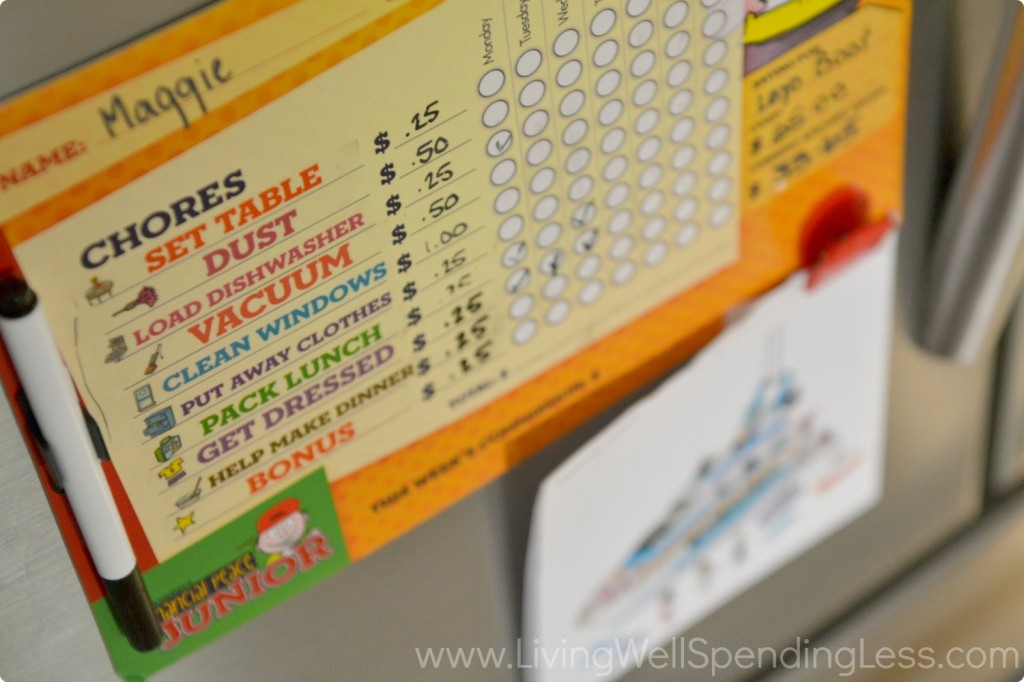
We have set this up in my house, and let me just tell you, it works! The closer it gets to payday, the more enthusiastic my girls become about helping out around the house. They absolutely love filling the check marks in their chore chart, (we use the ones in this Financial Peace Jr. set) then counting up their money at the end of the week. Our payday happens on Sunday night so they have all weekend to boost their payout. Their chores and pay scale are based on their age—7-year-old Maggie has a few harder tasks that can earn more money, while 4-year-old Annie simply earns a quarter per checkmark.
2. When it is Gone, It’s Gone
Teaching kids that actions have consequences is a lesson that goes far beyond money. It is so hard to let your kids fail sometimes! Both my husband and I have a really hard time with this, especially when it comes to money. Rather than letting them make bad choices and then experience the consequence of that choice, we simply say, “no, you can’t buy that,” and all their money stays in the bank. After reading Smart Money, Smart Kids, I realized that we do need to let them experience the process of spending the money that they earn so that they can also learn that when it is gone, it is gone.
3. It’s Okay to Wait
We live in a world of instant gratification, one that is becoming more so all the time, and there are sadly far too many kids who grow up thinking that if they want it, they should have it right now.
A few years ago, as the director of a large day spa, I saw this all too frequently with my entry-level front desk employees, who were mostly girls in their late teens and early 20s who thought working at a spa would be glamorous and easy. I can’t even tell you the number of times one would ask for a raise after just a week—or sometimes even a few days–of work. They had been so accustomed to being rewarded for nothing, they had no concept of delayed gratification. It was sad, and as an employer, extremely frustrating!
DIG DEEPER
We invite you to join more than one million subscribers in getting regular tips & advice via email. When you subscribe you’ll also get access to our game-changing Living Well Starter Guide as our gift to you!
Through their commission system, my own girls are slowly learning that it is okay to wait and save for the things they want. Right now they are each saving for a (ridiculously overpriced) Lego play set. $65.00 is a huge number when you are only earning $0.25 at a time, but they are both doing great. Each week they get a little closer to their goals, and each week they become a little more motivated to work harder. I’m pretty sure I will cry the day we finally get to go to Target with their jar full of money to pick out the toy they worked so hard for!
4. It’s Not All About You
Not long ago I was stopped in my tracks by one simple but life-changing question: What are you doing with God’s money? As a Christian, I believe that what I have is not my own. It is a responsibility I take seriously. I am called to be a good steward of the resources I’ve been given, and just importantly, I am called to teach my children to do the same.
But in all honesty, this calling is not a burden. There is no greater joy than teaching my kids how to give! We do this in lots of different ways, especially at Christmas, and our favorite ways to give are with our time, not our money. Even so, it is important that my kids understand that they money they earn needs to be shared.
Each week, at payday, they first put a portion aside to put in their give envelope. They get to decide how much they will give, and they also get to pick the recipient, since at this point we are far less concerned with who they give to than that they experience the joy of giving. I’m sure our giving plan will evolve and adapt as they get older, but it will always be an important part of their financial education.
5. Tell Your Money Where to Go
Right now our primary focus is teaching our kids the basic concept that money comes from work. Even so, by teaching them to divide their money each week into their spend, save, and give envelopes, we are also trying to set the foundation for learning how to budget their money. We want them to learn while they are very young that if you don’t tell your money where to go, it will go away. It is a concept I wish I would have learned much earlier in life!
While the envelope system works great for younger kids, older kids need to be given even more responsibility for their own budgets. By the time they are teenagers, kids should know what their main expenses are–everything from entertainment & activities to clothing, food, and savings–and how to create a simple budget each month to make sure they are living within their means. (There are some fantastic tips for exactly how to set this up in Smart Money, Smart Kids.)
6. Don’t Buy Things You Can’t Afford
In today’s society, our instant gratification mentality has also transferred to our wallets, where we buy things we can’t afford with credit cards so that we can have them right now. Teaching my kids that credit is not the answer means that I have to be willing to live by this philosophy too. After all, if they see me buying whatever I want, regardless of my ability to pay, my warnings not to use a credit card won’t mean a whole lot, especially as they get older. Instead, our goal is to model for them a cash budget system, one where we save for the things we really want just like they do.
As they get older, they will have to learn how to save for bigger things like college or their first car. While car payments and student loans have become the norm, they shouldn’t be. Kids today are graduating from college saddled with huge debts that in many cases could have been avoided with more planning and better choices. We are determined to not let our kids become a statistic by teaching them now that credit is not the answer.
7. Choose Contentment
While all this other stuff is important, helping my kids learn to live with a spirit of contentment is by far the most important lesson I will ever teach them. A wise person once said that there are two ways to be rich—one is to have everything you want, and the other is to be satisfied with what you have.
At our house we call this our “Attitude of Gratitude,” and it is a subject that comes up a lot, especially when my kids start to get whiney or entitled. Last month, for instance, we decided to surprise the girls and two friends with a visit to Disney on Ice, which was touring nearby. As we walked into the arena, they were positively giddy with excitement. Until, of course, they spotted all the light-up wands, cotton candy, stuffed toys, and other assorted trinkets for sale. Their attitudes instantly shifted from excitement to longing. After listening to several rounds of “please, please, pleeeeaaase can we have that Mommy,” we gently encouraged them to list all the things they were experiencing (getting to see princesses, having a fun sleepover with friends, etc.), rather than focusing on things we weren’t buying. It completely changed their perspective, and we all had a great time. (And just in case you are wondering, yes, my husband and I sometimes have to remind each other of this too!)
Choosing contentment is a daily battle and a choice I have to make right alongside my kids. It means choosing to count our blessings rather than focus on what we don’t have. It means remembering to say thank-you, and to stop comparing. And it never, ever ends.










 Tim Connolly