Research shows that an overwhelming 81 percent of parents feel it is their responsibility to teach their kids about money and savings, yet only 63 percent of parents stated their children had a savings account, and only 27 percent actually indicated that they take their children into a physical bank to make an account transaction at least once a month.
This data, derived from a national survey of more than 2,000 U.S. parents conducted by DoughMain, a free financial education and family organization website, aimed to reveal how kids are interacting with money in their everyday lives. There was a clear need for tools to educate children about financial literacy, and a disconnect between what parents believe is their responsibility and what they actually take on.
The Consumer Federation of America and American Savings Education Council also released research in February that shows Americans are still struggling to save, that savings habits have slowed down in the U.S. overall, and that families are not actively creating savings goals.
DoughMain’s study also revealed that:
• 63 percent of kids 18 and under have savings accounts, and 73 percent of those savings accounts were started before the age of three. • 43 percent of parents review bank statements with their kids monthly. • 51 percent of parents give their children allowance, but only 4 percent require them to deposit that money into a bank account. • Only 28 percent of children have used online banking to view their savings account balance. • For children without savings accounts, their money is most frequently saved in a piggy bank, bonds/CDs, or checking accounts. • Only 38 percent of parents are matching their children’s savings. • Only 30 percent of children give some of their savings regularly to charity
“We want to see 100 percent of American children saving wisely, and from this survey, we can see that’s clearly not happening,” says Ken Damato, president and chief executive officer of DoughMain. “This research exposes that while parents want to be the primary finance teachers to their children, they’re just not doing it to the degree that’s going to make a real difference for the next generation.” Damato continued, “Things as basic as opening a savings account or how to read a bank statement are just not being taught in the classroom, leaving parents to be the primary educators about finances.”
Top 5 Tips for Teaching Your Child about Saving
1. Open a savings account for your child. 2. Take children to the bank to see how deposits work. 3. Help kids set savings goals and/or create family savings plans. 4. Start a family match program. 5. Use allowance as a learning tool.
The Benefits of Teaching our Kids about Money
There are many benefits to teaching our kids about money, for us and them!
In making a commitment to do this, it makes us look at the way we ourselves behave around money. If we constantly spend without saving or pay little attention to what is coming in and out of our bank account, we aren’t going to be in a position to set a good example. That isn’t to say we can’t, it just means our children learn by watching us.
If we can get to grips with some basic information to pass over to our kids it enables us to look at the way we manage money ourselves and work to improve that, thus providing a better example for our kids to follow.
As with anything, our kids learn their behaviour by what goes on around them. As parents we impact heavily on this. School, friends, family and other environments they are open to will affect the way they learn about money too.
If we are consistently giving them positive messages about money, this will become their normal. To give you an example of this, most of us can probably relate to being told certain things about money when growing up. As a child you take things literally and so these things take root and become your beliefs around money. For example, imagine you are told every day that there is not enough money, money doesn’t grow on trees, money is the root of all evil and money is hard to come by. As children, the messages we are given around money will most often shape our beliefs and behaviours around money as we grow into adults.
As a parent, you want to prepare your children for their adulthood in the best way possible. You can provide financial education to kids or teach them lessons on planning, budgeting and saving, but you could also look into the benefits of a Junior ISA and how this could help your child to start saving or investing in their future.
Payday
Want to show your teens what you go through financially each month? PayDay could help since it places players in real-life financial situations. The board game takes the form of a monthly calendar and you get paid at the end of each month. In between, you need to deal with everyday expenses like bills, food shopping, or unexpected payments. The winner is the person who has the most money at the end of the last round. Therefore, playing PayDay can be a good way to teach teens useful financial skills, like saving and budgeting, which in turn could help them enter the investing world in the future.
Monopoly
No list about money games would be complete without Monopoly! We’ve all played it at least once in our lifetime and the game is still very popular today. By playing Monopoly, teens can learn about planning for the future and delayed gratification. Indeed, the game is about buying properties in the hope of collecting rents, hence making potential gains later – a bit like investing where you put money in stock markets in the hope of getting a return over the long-term. Monopoly can also help teens understand the importance of saving money to afford expenses. Whilst the aim of the game is to amass as many rent payments as possible by purchasing properties, you also need to keep enough cash aside to be able to pay rents yourself without going broke.
The Sims
The Sims is a simulation game which can help teens understand that patience, hard work, and saving are key to keep their finances in shape and bring their long-term goals to life. With The Sims, you have to build virtual characters and get them through everyday activities, such as eating, socialising, sleeping, and managing money to bring projects to life. At the start of the game, you are given a budget and need to make it grow by getting your protagonist a job, so you can afford expenses (e.g. bills and groceries) and purchase new exciting things, like a swimming pool or a car.
Football Manager
With this strategic online game, teens can build and manage a football team, but most importantly, they can learn that financial management is about finding the optimum balance between their wants and needs. When playing Football Manager, you’re given a transfer budget and can use it to buy players. This requires you to make cost-effective decisions by getting the players you think could help the team win but without overspending and damaging the club’s financial state. The game could teach teens to review their finances before spending or investing money.
Dungeons & Dragons
Dungeons & Dragons isn’t only about battling against others. In fact, it can teach teens about saving and planning for the long-term. Throughout your journey, you can earn gold and silver coins and you’re allowed to spend them to buy items that might help you survive longer, such as a better suit or more efficient weapons. However, the trick is to have enough funds to face any unexpected events and achieve your long-term goals.
Please remember the value of your investments can go down as well as up, and you could get back less than invested.
Sometimes we get hung up on the details don’t we? We worry so much about our approach that we never get our ideas off the ground. This can be true in so many areas of life – particularly when we want to try something to help our kids. However, this is one area where you really can’t mess up. If you do something purposeful in Teaching Teens About Money, then you are way ahead of the game! It may not be perfect but it’s SOMETHING. So have a conversation with your teen, pick a system that works for everyone, and get started! Here are a few ideas:
Saving A Percentage
Sit down with your teen and decide (with them) what they need to be saving for in their life. Come up with the percentage that you both believe is reasonable for that savings. Do they need a car? Maybe they should save 50% of all of their earnings for that purpose. Do they want to go to college? Then maybe they need to focus a higher percentage towards a college fund.
The Envelope System
Establish envelopes for each savings category. They decide in advance how much of their money will go into each of those categories each time they are given or earn money.
Even a small amount adds up over the years…
Keep Gifts/Budget Earnings
Some parents choose to allow their teens to do whatever they want with money that they are given at holidays or on their birthday but ask that they carefully budget the money that they earn or are given in the form of allowance. This approach allows the teen to have complete control over some of the money they have coming in and somewhat less control over what they earn on a regular basis.
Save Half
This is just so easy! Have your kids save half of everything they earn or are given! I personally think this is easier to do if you are dealing with a very young teenager, because they are less likely to have other bills like gas or insurance for a car. However, it is a great habit to be in and can always be adjusted when the teen begins to have other expenses.
No More Allowance
Some of our friends no longer give their older teen an allowance, particularly if that teen has a part time job. At that point, they are expected to pay for their own entertainment expenses and such. Those same parents may still require that teen to save a portion of their income for long term goals like college.
The Parent 401K Matching Program
This is a system that Dave Ramsey used with his kids. Basically, when his young teens got to the point where they were thinking of saving for a car, he did a ‘matching program’ with them. For every dollar they saved, he saved one as well. This doubled their money and allowed them to buy a decent used car once they had saved for several years. I know, I know. Many of us would love to do this, but are simply not able to help our kids in this way. BUT – if you can – it’s a great way to give an incentive to your teen for saving their money. Maybe you could do a 50% match or less if you cannot do a 100% match.
Teen Directed
This is the system that most parents fear… Many of us are afraid to trust that our teens will save enough of their money. However, if they are the ones earning the money, most people would agree that they should be the ones directing where their money goes. This is a loose system where the parent guides the teen and has established a good foundation of financial literacy with their child. At that point, the parent steps back and gives the young person the freedom to make their own decisions.
No Requirement
Okay. In accord with my own ‘no judgement zone’ guidelines, you can decide to do absolutely nothing to help your teen learn how to save their money. And that is a viable option. And no one is going to say a word about it to you. A lot of people didn’t know a thing about managing money and are happily digging their way out of debt as adults and they are doing just fine….ahem.
You can get Eva’s e-book for free by signing up on the home page. It has practical tips to help your teen think about how they can start a savings plan.
So – whatever you decide to do, remember that any system is going to help your teen. You cannot make them handle their money wisely as adults but you can give them the tools that they need in order to get started on the right foot. It is my opinion that if you simply impose something like this on them without a respectful conversation discussing options and what you want to help them accomplish, then you are risking great conflict in the relationship. Be honest about the mistakes that you have made with your own finances, and be transparent about the steps that you are taking to correct those errors. Explain how you want to help them move toward financial literacy and complete independence. Make these decisions with them so that everyone is on the same page.
Eva’s envelopes…
Eva has an envelope system that she uses. She directs how much of her money goes into each of these envelopes and currently has college, retirement, car, spending and clothing categories. I asked her what she would do if she had $25 to put in her envelope. At this point, she would basically put $5 in each envelope. I think that she should think about putting more in her college envelope at this point, but am willing to allow her to make that final decision as long as she is saving for college. We probably need to take a much closer look at how much college costs will be so that she can have a better understanding of how much money needs to be in that envelope by the time she graduates from high school.
What plan are you currently using to help your teens save? Do they want to save their money or not?
Playing checkers with one of my boys the other day, his eyes started to well up as I was sweeping the board with him. He’s really competitive and does NOT like to lose. And he was REALLY losing. The apple didn’t fall far from the competitive tree there.
After that game, I thought about how we could make this a teachable moment. I told him I’d teach him how to beat me so he could stop feeling that way every time we play each other. The next 15 or so games, he hung on my every word. He still lost every single one of them, but this time he saw the purpose.
We don’t move the pieces from the back row so we can prevent our opponent from getting a king.
I like to flank the outside to make it easier to streak down the board and stay away from the opponent’s pieces.
I’m OK with sacrificing one piece if it means it sets me up for taking two or three pieces on a future turn.
Within two weeks of this crying moment, he beat me. I tried every tactic in the book to get one over on him. I did NOT “let” him win. He actually beat me. He learns quickly, and that’s both exciting and frustrating!
You should have seen the look of pride on his face. He was beaming. He told the next 50+ people we saw that he just beat Daddy in checkers. Most didn’t realize the importance of that lesson, but oh man I did.
Failure is how you learn
James Allen, author of As a Man Thinketh, said “Failures are the steps in the ladder of success.”
Henry Ford said, “Failure is simply the opportunity to begin again, this time more intelligently.”
John Maxwell, author of a The 21 Irrefutable Laws of Leadership (among other titles), said, “The more you do, the more you fail. The more you fail, the more you learn. The more you learn, the better you get.”
When you fail and take the time to analyze how and why you failed and then implement steps and habits to prevent from those reasons coming up again, you set yourself up for success. Each failure gives you a learning opportunity, but only if you let it.
How Do I Fail in Teaching My Kids Money?
Sure, there are tons of ways you can fail here. You could flat out tell them incorrect information. You could set a bad example. You could cause them to lose money.
But the number one way you fail in this endeavor?By failing to start at all. Think about that. Even the act of complete inaction is, by its very nature, still action.
Your kids are going to learn about money whether you intentionally teach them or not. The question is, WHAT ARE THEY LEARNING?
Jimmy gets money from grandma for his 5th birthday and you take him to Target to pick out whatever toy he wants that he can afford. If you haven’t been intentional about this subject, then this little trip to Target teaches Jimmy to spend any money he’s given. Teaching him to budget early on allows him to set spending goals for his priorities, and it lets you teach the importance of saving for the future, before he’s spent all the money.
Twelve year old Colton comes to you and asks if he can have $5 to get ice cream with friends, and you give it to him. What you didn’t know was that your husband already told him no. Without a plan of how you’ll use your money and making everyone aware of the plan (check out creating a family mission statement for this!), your kids will naturally know to play you against each other. If you’re married, one of the best things you can do is approach this topic as a united front.
You’ve been telling Caitlyn since she was twelve that she was going to be buying her own car. She waits until a month before her 16th birthday to ask what kind of car you’re getting her. If you buy her one now, then you’re teaching her that you’ll always bail her out of her bad decisions…why should she learn how to make good decisions if you’re just going to save her?
So where do I start?
The easiest place to start is literally anywhere. Figure out what your kid knows about money and then find ways that how you can provide more financial education to your kids. Depending on your kids’ ages, these questions could be pretty surface level or really really deep.
Some straightforward ideas to kick it off for you:
Count your kids’ piggybank money with them.
Take your kid to your local bank and set up an account.
Split some of the money they have into saving (and investing, if you’re ambitious), spending, and sharing categories.
Talk to them about the things they want to spend their money on and write them down.
Help them do the math with how much they need to save up to be able to make the purchase on their own.
If your kids are older, talk to them about what big expenses are coming up.
Help them create a plan to save a certain amount each month to meet those goals.
Remember, failing to teach your kids about money doesn’t just mean you failed, it means your kids are failing, too. And, if you’re like me, that stings.
Actionable advice:
Have a conversation with your kids. Ask them what they know about money. Leave it open-ended and see how much they can tell you. This obviously works really well with younger kids. If you have teenagers, good luck. I’m working on figuring those out!
Be intentional about your money lessons. They don’t need to be grandiose.
Set a good example. Remember, children close their ears to advice but open their eyes to example.
Are you intimidated by the idea of what to teach your kids about money? Does teaching your kids about wealth and personal finance send shivers down your spine?
As a parent, you may feel worried that you don’t even know enough about money for yourself much less enough to teach other people about it.
Thankfully, personal finance doesn’t have to be complicated (and the topics that are more nuanced probably aren’t the best place to start teaching children, anyway!).
While you may not be an expert on the nitty-gritty details of personal finance yourself, there are many powerful life lessons about money that you can teach your children regardless of how much you earn.
In this post, you will learn eight powerful lessons that will help you in teaching kids about money and perhaps reinforce some good financial beliefs in yourself as well!
Living a full life doesn’t require riches
In reality, this might be one of the financial lessons that kids can help to remind us of.
As children, few of us were fixated on keeping up with the Joneses’ kids. Once our basic needs were met, we were able to enjoy creating new things, playing with others, and experiencing the world around us without a focus on money. If you want to live life to the fullest, you don’t have to be rich.
Do you want to live a better life? Don’t assume that the answer is earning (or spending) more money. There’s a lot more to being the best version of yourself than driving a nice vehicle (with a huge car payment), living in a big house, or having a lot of money in your bank account.
If you’re seeking more in life, why not try:
Doing something that scares you
Practicing daily gratitude
Being kind to someone each day
Building a strong financial foundation can bring you peace of mind and give you more options and opportunities, but don’t ever think that money is a magic pill that will lead you to a happier life.
There’s more to money than income or net worth
Your financial legacy is more than your net worth.
Take a moment to consider the financial legacy that you’ve received from your parents – and the legacy you want to leave behind for your own kids. Some of the most valuable aspects of a financial legacy don’t involve numbers at all.
The financial legacy of your parents has shaped your beliefs and attitude about:
Whether you are “rich” or “poor”
How much money you are capable of earning
What’s worth spending money on or saving for
And more…
There’s nothing wrong with wanting to pass along generational wealth – or if you’ve received a large inheritance yourself – but passing along the right financial skills and values may be the most valuable gift of all when it comes to preparing your kids for a lifetime of successful money management.
There’s a difference between rich and wealthy
Understanding the difference between being rich versus being wealthy is one of the most valuable lessons you can teach your kids about money.
In the same way that waking up early doesn’t guarantee you’ll have a productive day, being rich doesn’t guarantee that you’ll become wealthy.
In addition, you can teach your kids that looking rich is not the same as being rich.
Although you don’t need to read The Millionaire Next Door as a bedtime story to teach them the concept of stealth wealth, you can help your children recognize that financial freedom comes from living within your means and saving for the future rather than earning or spending lots of money.
It’s never too early to start saving money
There’s no better time than now for your kids to start learning about the power of delayed gratification. At this stage of life, time is their most valuable asset.
Teaching kids about money can feel like an overwhelming task, but it is one that is crucial to ensure that your child knows how to manage their money well later in life. That’s why we’ve used the experience of many of the teachers here in the Third Space Learning office to provide you with 11 ways and activities to teach children about money!
Teaching kids about money – why is it so important?
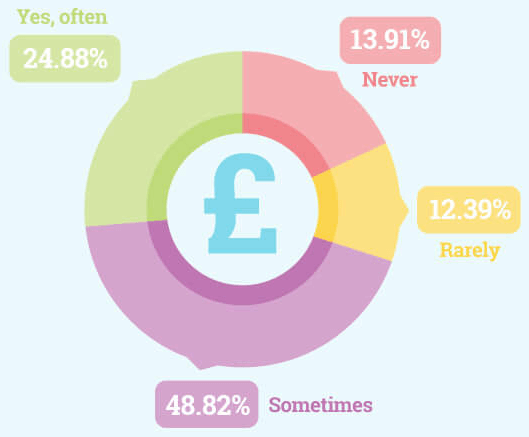
As outlined below, when asked, ‘Do you ever discuss savings or the importance of money with your child?’ about 75% of us admit to not talking about this critical subject:
However, with research indicating that our spending habits are formed by the time we reach 7, it’s important to think about how best we can pass on money skills to our children at an early stage. Here are our top home learning tips, activities and games you can use to help your kids learn about money in a fun and engaging way.
1) Encourage children to count coins
One of the hardest things to convey when beginning to teach kids about money is the value of coins. With some coins looking similar to unfamiliar eyes, think the 1p and 2p, the 20p and the 50p, it is important to make sure your child has grasped the basic concept of what each coin is worth.
If you are wondering how to teach your child the value of money then you will be pleased to hear that there are a number of things you can do. The most simple of which involves laying out all denominations of coins and talking your child through each one and its value.
If however you are looking for a simple money game for your child, the following is a good one to start with:
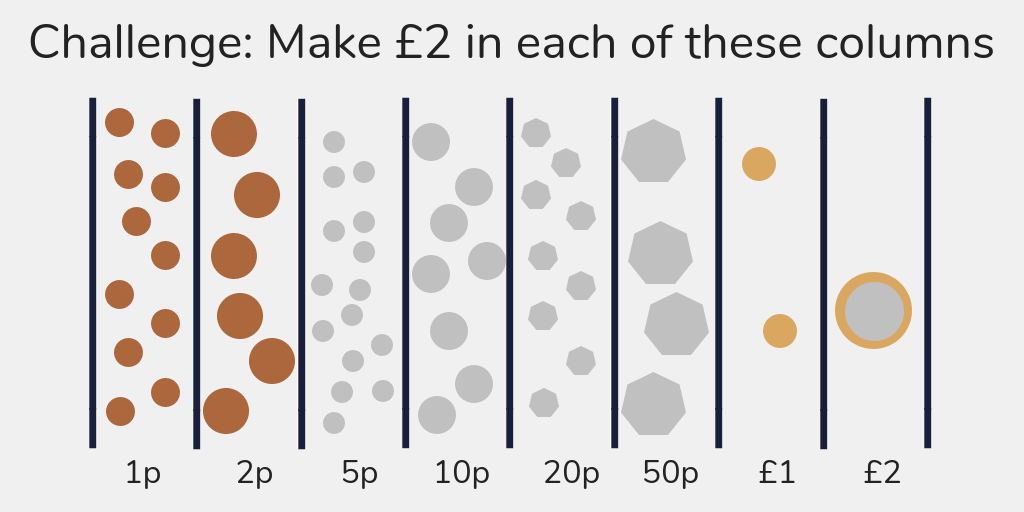
Step 1: Gather lots of coins together with your child (1p, 2p, 5p, 10p, 20p, 50p, £1, £2)
Step 2: Choose an amount of money you are going to make using all of the denominations of coins available (we recommend £2 to keep the number of coins needed to a minimum)
Step 3: Show(or let your child work out) how many of each coin is needed to make the desired amount. E.G you will need 200 1p coins to make £2, two £1 coins to make £2 etc.
Step 4: Let your child visualise the values of the coins. To reinforce the concept, ask them to try building their own piles.
2) Go shopping together
Teaching kids about money should involve giving them an idea of how much things cost, as this can definitely be an issue when you are out shopping with your child. We’ve all had a conversation that goes something along the lines of:
“Mum/Dad, can I get that toy please?“
“It’s very expensive. Have you seen how much it costs?”
“No, I don’t know. I just want it!”
Thanks to years of balancing the budget, as adults we know that expensive items are treats, however, many children have not yet been introduced to the concept of understanding how much things cost.
To help overcome this, take your child shopping and show them the cost of different items. When at the shop, involve them in decisions and explain your choices. Make sure to bring cash. Let them count out the money and hand it over to the cashier so they begin to think about the process of spending. Ask them to check the change after so they get used to the mental calculations required.
All of this should help them begin to realise that whilst money = items when in a shop, different amounts of money means you can buy different amounts of items. Sometimes teaching kids about money means going back to basics to ensure key concepts are grasped.
3) Rather than giving an allowance, consider giving your child a commission instead
Whilst the giving of an allowance, or pocket money, is common in many homes across the UK, you could consider giving your child a commission instead. By doing this, instead of simply giving them money for no real reason, you will be paying them for the chores they do around the house like cleaning their bedroom, vacuuming and washing the dishes.
This will help them to realise that money is earned instead of simply given to them, and is a good mindset for children to get into early in life.
It is a small change to something you may already be doing, but it is one that will help prepare your child for a pocket money free future!
4) Dig behind the couch and save pennies
Give your child a glass/clear plastic container so they can start storing their commissions and learn about the concept of saving. It is important that you use something clear or transparent as this means that your child can see the money increase each week and grasp the value in setting aside money.
Remember, there’s no better way of teaching kids about money than giving them visual examples.
If you’d like to go further, you could provide separate jars for each coin. You could then ask questions such as: ‘Which jar has the most value?’ Though the 2p jar may have the most coins, it probably won’t be as valuable as the one-pound coin jar.
5) Take a trip to the bank
This tip may not seem like the most exciting day out to your child, but they will definitely thank you in the long-term!
Take them to the bank and open up a savings account under their name. This process will help to illustrate the differences between digital and paper currency. Once their savings jar is full, go back to the bank so they can deposit their funds!
6) Hold a cake sale
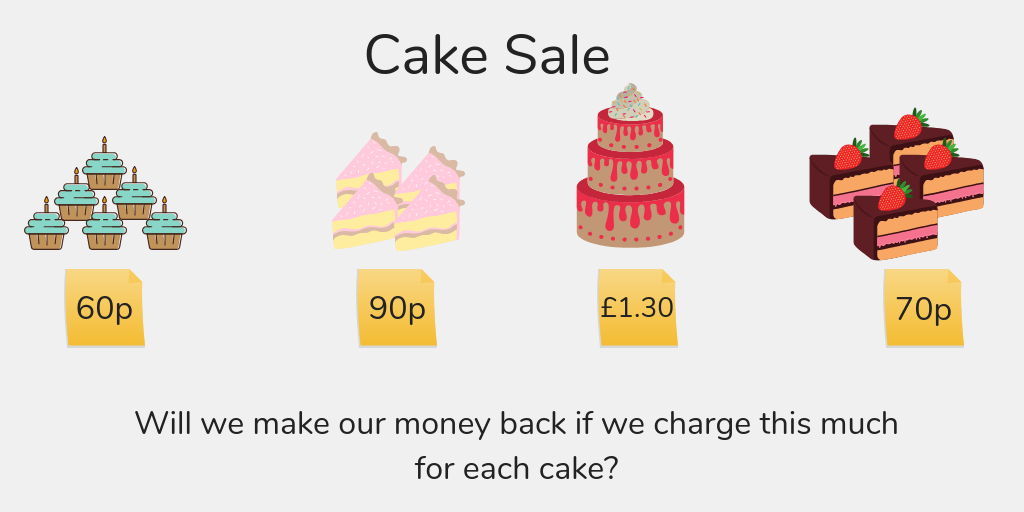
Do some baking with your child and hold a cake sale to raise money for charity. Ask them to set the prices for each item and question their choices. For instance, outline that items possess varying values and the reasons why you may spend more or less on certain things. Allow them to handle money with customers and set them the challenge of counting how much you’ve raised at the end.
There are a lot of different questions you can ask them during this process to help them understand many different facets of money managements. Examples include:
Which cake should be the most expensive?
Which cake cost us the most to make?
How much shall we charge for each cupcake?
Do we do any deals? If all the cupcakes cost 60p each, could we sell a box of 6 for £3 to make people buy more?
Many more questions will come up as your bake sale runs on, but these are a few examples to get you going!
7) Pause for thought when it’s time to pay for a meal
Can your child help when you pay the bill at a restaurant?
Whilst it may be a little mean to try to split the cost of the bottle of wine with them when they were only drinking juice, a restaurant presents a good chance to teach children about money.
You could discuss which card is best to use: debit or credit card, and explain the positives and negatives of different methods of payment provide. This will be a valuable life lesson.
Whilst your child will not be coming into contact with a credit card of their own for many years, it is crucial that they understand cards are not a way to access “free money” and that eventually they will have to pay for whatever they have bought.
8) Get every member of your family involved with discussions about your household budget
Involving your child in some of the basics associated with your household budget will help to illustrate the importance of money. Can they help you work out what percentage of your income goes towards bills? Can they calculate how much this leaves for other activities?
If you are feeling brave, you could ask them to come up with ideas for reducing spending in certain areas.All this will help them with their own budgeting as they get older. Take a look at this video by the Money Advice Service for further ideas:
9) Explore money in the context of the wider world
Though money makes the world go round, there is considerably more money going around in some areas of the globe than others.
Helping your child understand the differences in global wealth will not only enhance their understanding of money, but also provide them with some useful general knowledge. The following information might help to get you started:
There are a number of questions that could be inspired by such figures, not least why some parts of the world have lots of wealth despite having a smaller population.
10) Introduce the idea of opportunity cost
Put quite simply, this means showing your child that if they spend all their money on item A, the cannot have item B as well. In an ideal world we would all be able to buy that new TV, sofa and dining table, but as adults we know that this isn’t possible (until those lottery numbers come in anyway…).
That is why this is such an important concept to introduce to your child.
11) Introduce the 24 hour rule when it comes to impulse buys
A surefire way to help when teaching kids about money is to tell them about the 24 hour rule they should use when out shopping.This is a question that many of us have faced, with primary school aged children being masters of capitalising on the impulse buy, especially with someone else’s money!
To overcome this, let your child know that they are free to use their hard earned commission to buy it, but only on the proviso that they wait 24 hours and still want it then.
More often than not they will either forget about the purchase or decide that it doesn’t look as great as it did a day ago, and you can then use this as a teaching moment to show them why impulse buys are often not the right choice!
Teaching kids about money – The most important tip of all
One of the most important things to remember when considering financial education for children is that as a parent, you are setting an example for them about how to handle their finances later in life. We understand that it can be difficult to juggle the often hectic parenthood with additional teaching, but to ensure your child knows how to successfully manage their money when they are older, taking the time to show them now is well worth it.
Teaching Teens About Money is so crucial! Today, you’ll not only learn how to teach them, but also why you should. It’s never too late to teach your kids about money, so this works great for toddlers and teens, alike.
We all want what’s best for our kids, that’s just a given! We want them to grow up big and strong, be confident in themselves, and go out into the world as capable adults. In order to be successful in our world, kids need to understand how to use money! Money is going to be such a BIG part of their lives! That puts a lot of responsibility on us parents *Breathing in paper bag*
It’s okay! Put that paper bag down and come learn how to teach your kids about money, the easy way! Start off by making sure that you are open with your kids. Talk about money! Be an example of how to spend responsibly and even more important – how to save money. This will set you up to teach your kids to save and spend their money the right way!
Keep reading for more tips on how to set your kids up for success! Plus, we’ve got a great printable that will help them to save for specific goals. So whatcha waiting for? Let’s get on to…
TEACHING KIDS TO SAVE MONEY
Our kids need to learn to be responsible with their money. They need to know how to save their money for long-term goals, how to spend their money responsibly, and even that it’s good to tithe to the church or a charity of their choice. Those may all sound like hard and scary things to teach them, but they’re really not!
THE 70% RULE
Teaching kids to save money is easiest done by showing them how the 70% rule works. What in the hey ho is the 70% rule??? Don’t worry, here’s brief explanation for you!
As adults, you would first figure out your take-home income. Then, you divide that and figure out what 70%, 20% and 10% of that take-home would be. Designate 70% for spending, such as bills, mortgage, groceries, hair cuts, etc. 20% goes towards saving and 10% towards tithing/charity/etc. (You still with us?)
MODIFIED 70% RULE FOR KIDS
Kids are lucky in that they don’t have any bills that they have to worry about paying yet! (Unless they’re older and are helping to pay for their phone bill, perhaps?) So rather than doing the 70/20/10 rule, we modify it a little bit to help them learn to save, save, SAVE!!!
The 10% stays the same. It’s still a really good idea to have them learn to be generous and put that aside for whatever cause they want to support. But rather than having 70% go to spending and only 20% go to saving, modify that!
Take that remaining 90% and split it up evenly! 45% goes to long-term savings and 45% goes towards spending (or short-term savings). To make it more visual and fun, grab one of these “Save, Spend, and Share” piggy banks so they can manually divide up the money and watch each fund grow! Got the picture? Now that you know the basis behind all of this, let’s get on to…
HOW TO TEACH KIDS TO SAVE MONEY
Saving money can be hard! That’s why it’s important that we learn these principles as early as possible! It’s so hard to try to learn this once you’re an adult and you’re out on your own for the first time. So let’s help them out by teaching kids to save money at an early age.
Note that “early” for some may be 3, while it may be 15 for others. As long as you’re teaching them how and why they should be responsible with their money, then they’ll have the tools that they need to be successful with money in their life!
Here are a few of the different concepts that you should consider when teaching kids to save money. They’ll really help them to go further in life without the stress of pressing debt!
A Want Versus a Need – While they may really want something, it doesn’t necessarily mean that they need it. Helping them save up money over a period of time will give them time to think long and hard and will also help them make sure it’s worth their money.
Delayed Gratification – Helping kids develop a little self control will help them achieve their goals in every area of their lives. Why not practice with money now!? If kids have a chance to work and save up for things that they want, they will appreciate it so much more. Which means they’ll probably take care of it better, as well!
Avoid Borrowing/Debt – Kids should learn to work hard so that they can pay for something once they have all of the money – another important principle to help kids avoid debt.
Money Doesn’t Grow on Trees – Teach your kids that money is earned, not just given freely! If they want to make extra money, then they can do extra chores around the house or get a job.
Long-Term Savings – College tuition. Does that send a chill down your spine? Teaching kids to save money for the long-term is essential! Explain to them that what they’re saving for now will be very beneficial for them later in life. One day, they’ll need to buy a house, a new car, and other big things like that. Really teach them how important it is to save so that they won’t go into debt later in life when they’re needing to buy all of the big and important things!
Keep Track of the Money – As adults, it’s so important to keep track of your money going in and out. It’s the same for kids! Teach them to track their money so that they not only know how much is going into their different accounts, but also how much they’re taking out to spend. Tracking spending is a life skill that will help them make better choices in the future.
Are you starting to see why it’s so important to be teaching kids to save money so they can develop good money habits when they’re young?! These are such big concepts that we, as adults, can struggle with. So let’s help our kids out by training them young to think differently and think long-term versus having the “I want it now” mindset.
HELP KIDS SAVE FOR A PURPOSE
Now that you know all about teaching kids how to save money, let’s go over how to help them save their money short-term for a specific goal! Remember, this money is coming out of their SPENDING money (aka short-term savings), not their long-term savings.
Help them to figure out what they’re wanting to save their money for. This could be anything from a pack of playdoh to a basketball goal. The amount doesn’t really matter. It’s more about the journey that they take and the steps that they go through to save that money (from their spending money) and reach their goal!
My son is approaching his 3rd birthday so we’re just beginning to introduce him to the concept of money and, I suppose very distantly since the topic is fairly intangible at this point, financial responsibility.
1) Talking about money whenever the moment comes upon us
2) Familiarizing our son with real money.
I want my son to feel comfortable and secure when dealing with and handling money whether it is spending, saving, investing or donating. I want him to be confident in his decisions, feel and actually BE responsible. A little intangible but important.
STEP 1: TALKING
The good news is that lately our son has given us plenty of every day opportunities to guide him.
So, at least he is understanding the “currency exchange for goods” concept but we all know that isn’t enough. The conversation ended with us talking about ways HE could EARN money to buy the train himself. We talked about chores as one example. He actually became very excited about this idea and proceeded to run around the house pointing at all the things he could do for our home, “I will take the recycling out for you, mama! I will sweep the floor! I will put the clothes in the dryer!” All very endearing to me. Sentiments that I hope we’ll be able to cling onto for at least a short while.
STEP 2: FAMILIARIZING
Before starting this journey of physically exploring coins, I set two very simple GROUND RULES:
Coins can be in your hands, on your leg/lap, on the floor, on the table to list a few reasonable place. Notice the list does not include “in the mouth”.
Coins should remain in hands, on legs/laps, on the floor or on the table. Notice the list does not include “in the air”.
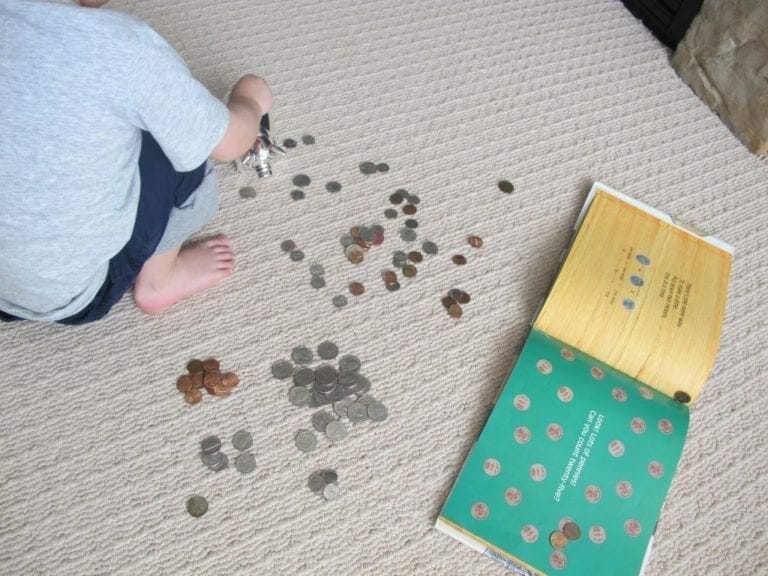
Familiarizing him with actual (gasp!) money takes patience, or at least does for me. My son is still in the very early phases of developing self-control. So he immediately likes to fling a coin or test me by putting a coin close to his mouth. He also gets a bit defensive when he is experiencing a new concept, one that he hasn’t yet learned and doesn’t get right away. I think that a lot of kids behave this way. So, sitting down with my child, fingering through coins, talking about each one…trust me, all of these simple actions adds to our children’s true understanding and ability to grasp “money”. We counted, sorted and stacked coins, all to get familiar with each coin.
On a final note, these ideas are not going to become ingrained or learned overnight. I plan on introductory activities like the ones above to be a part of our lives a few times a week for the next several months. Then we’ll move onto bigger and better, arguably more exciting (at least to the Mama) part about learning financial responsibility.
The fact that you’re reading this means you know you should talk money with your kid. Whether the subject terrifies you or intrigues you, or you’re simply looking for ways to broach the topic, the good news is that you’re plunging in. Go, you!
Though its title might make it sound like I’m expecting you to be a financial drill sergeant (“Now drop and give me 20 compound-interest calculations!”), I’m not. This chapter is the gentle one, meant to ease you into some overall concepts—and context—that’ll help you engage with your child about money. Some points will apply, others might not, depending on your kid’s age, interest level, and even gender. So don’t think that you need to commit everything to memory or take furious notes. The idea here is to put down your highlighter and just read.
One final thought before we begin: Money management for children don’t happen in a vacuum. Instead, they pop up at various times throughout the messy business of living. Though it’s become a cliché, most learning happens during these everyday “teachable moments.” The tips below and throughout this book are meant to help you take advantage of these opportunities. So here we go.
1. Start even earlier than you think you should.
By the ripe old age of 3, researchers at the University of Wisconsin–Madison report, many children are able to grasp economic ideas such as value and exchange, albeit in a very rudimentary way. They can also delay gratification and make choices. Though basic, all these concepts are important in understanding the role of money in our daily lives. Although there’s no economic equivalent of Baby Mozart videos, no stuffed dolls that look like Warren Buffett to tell your kid to “buy low and sell high” when you squeeze them, that doesn’t mean you shouldn’t pay attention to this stuff when your child is small.
Your toddler is eager, and able, to understand a lot. When you notice your little one “swiping” a pretend credit card, asking to push the buttons at the ATM, or looking through your wallet, instead of chuckling indulgently in a “kids say the darndest things” way, start teaching him some of the basic lessons in this book about where money comes from and how to pay for things. Even if your preschooler doesn’t absorb it all, he will still notice that you’re talking to him about something that matters—something grown-ups care about. And odds are, he’s already soaking up more than you think.
2. Keep it age appropriate.
Sticking to the truth is good when it comes to money, but so is adapting your message to your kid’s level. If you lose your job, it’s fine to say to your elementary schooler, “We’re going to cook at home more, since that costs less than eating out.” Given the same scenario but with a kid in high school, talking about how the loss of an income will affect college financing would be not only acceptable but also wise. You can discuss the reality that your family might not be able to put as much toward college expenses, but at the same time explain that she might qualify for more financial aid. In general, when it comes to having any hard money talk with your kid, it’s good to tell it like it is, but also offer reassurance that she—and you—will be okay.
3. Use anecdotes.
More often than not, when we launch into lecture mode, our kids tune out. Or, worse, our pontificate-y good intentions backfire and push our children to do the opposite of what we’re trying to get them to do. Instead, use stories to illustrate a point. When my friend couldn’t get a decent rate on a car loan because she’d run up too much debt on her credit card on a monthlong, over-the-top European trip the year before, I told my kids the details (without mentioning her name). Anecdotes such as these, which highlight how financial blunders lead to consequences, tend to stick in kids’ minds. Same is true of positive lessons, like an example of the neighbor who saved religiously for ten years, putting aside 1% of every paycheck, so that he could finally buy his dream fishing boat. You get the idea.
4. Use numbers, even if you’re mathphobic.
People understand money concepts better when a point is made with specific numbers.
5. Don’t lie about your money past — but don’t overshare, either.
Most of us have had a flirtation with bad money management at some point, whether we ran up too much on a credit card or bounced a check or two (or 10). But resist the urge to come clean about your money mistakes to purge your own feelings of guilt or irresponsibility: Your kid isn’t your financial advisor—or your priest.
Raising miniature humans is not for the weak at heart. Each day, parents face choices on how to mold their children.
Life skills like washing their own laundry and changing a tire don’t seem as much fun to pass along to our offspring. After all, no one gives our ribbons or trophies for folding your own underwear (maybe we should?). However, learning how to function in the world should rank in what you daily pass along to your kids. When it comes to money, there are plenty of ways to impart wisdom and foster independence in young lives.
Celebrate Opening a Bank Account
My grandma Beulah gave me my very own bank account for my 10th birthday. She deposited a small sum in the bank and wrapped up the brown savings book for me. I can still remember what it felt like in my hands. Each time, I made a deposit, the teller in our hometown bank wrote the balance on the yellow lined, small notebook.
While banking has changed over the years, it’s still important to celebrate a child’s first bank account. Build up the event as an important step in their maturity. Help your little count dollars or roll pennies. Guide them through the process of setting up the account along with the help of the bank employees, but don’t do all of the work or the talking. Allow your child to ask questions and to be a part of the experience.
Find the Best Account for Your Child
Be sure you set your child up for success by finding the bank account that fits his or her needs. Avoid accounts that require a minimum balance. Skip accounts that charge monthly fees. If you can, find an account that yields interest so that you can provide financial education to kids. You may need to go to credit union or find an online banking experience for a benefit like this.
No matter where you bank, be sure your child knows how their money is managed. Help them track their saving and spending through online services or by using a checkbook register. Don’t assume that they understand anything about the process. Explain and then over-explain each aspect. And if you don’t know an answer to a question your child has, ask someone so you can learn, too.
Select a Short Term Savings Goal
Saving without a purpose doesn’t usually create excitement toward a goal. Help you child select a worthwhile short term savings goal. For younger children, this looks like an item $25 or less. For older kids, maybe $50 or less.
Do research on where to purchase that item at the lowest price. Don’t forget to have your child look for coupons. Cut out a picture of the item and hang it somewhere where you all can see it on a regular basis. Help your child work around home or find a job somewhere in your community to begin making money to save. Once they’ve reached their goal, purchase the item in a timely manner. Then, set a new savings goal.
Don’t Bail
It’s so tempting to make up the difference when our kids arrive at the register to discover they don’t have enough money to foot the bill. While every parent can choose to exercise grace and generosity, try not to make a regular habit of swooping in with rescue cash. One of the more difficult lessons of learning to manage money well is realizing money is finite. There are limits to what we can and can’t purchase.
Without being cruel or mocking your child, explain in age appropriate terms that they will be unable to buy the item they wanted on this trip. Help them brainstorm ways to make more money so they can reach their goal quickly.
Put Your Child in the Driver’s Seat
Of course, don’t put your child in the literal driver’s seat unless he or she has a license. However, for interactions in commerce, allow your child to take charge. When they deposit money at the bank, have them fill out a deposit slip and speak to the teller. If your child is making a purchase, charge them with counting the money at home before you leave. Allow him or her to push the cart. And let them speak to the checkout clerk and pay for the item, too.
Some kids will find this process natural and fun, while others will struggle to muster courage and confidence. No matter how challenging the experience might be, realize that each time your child interacts with money, they’re learning life long skills.
There are a number of other money management lessons to impart to your children – from learning how to be generous to saving for emergencies, from staying away from debt to the discipline of saving for long term goals. Even when we don’t teach our children about money, they learn about it (in both positive and negative ways) from the influences around them. Take a proactive role in shaping their future through a healthy financial education.













 Tim Connolly
