Posted in Financial freedom, money management, Parenting, teaching teens

HOW TO TEACH KIDS ABOUT MONEY

If you’re like me, you can probably add “Human ATM” to your ever-expanding list of credentials. I realized very early on in my parenting journey I would need to have in-depth financial discussions with my kids beyond the “money doesn’t grow on trees” platitude. But where to start on how to teach kids about money?

“Don’t be afraid to have conversations about money with your children,” money mentor Miata Edoga tells Parentology. “Everything doesn’t have to be a big lecture.

Conversations she recommends, “Talk to them about how money is earned in your family, compare prices on similar items at the grocery store, take them with you to the ATM, explain the difference between debit and credit cards.

Edoga says there are myriad opportunities that come every day that lead to talks about good spending habits. “This dialogue accumulates and provides kids with a solid foundation from which to draw upon and make smart, informed choices.”

An earlier Parentology article titled “What is Financial Literacy for Kids?” discussed the basic principles of financial literacy; a set of skills that help someone make informed decisions about their monetary products and assets. In this article, we go a step further with tips and tools on how to teach kids about money that encourage them to establish good financial habits early on.

Wants vs. Needs

A good starting point can be as simple as helping your children understand there’s a difference between what they want and what they need. “Be clear in what you identify as a ‘need’. Things like food, shelter, and clothing are imperatives,” Edoga suggests. “The latest toy, not so much.”

Next, she says, “Once you’ve helped your child define both, you can start other conversations about spending, saving and prioritizing. 

How to Teach Kids about Money
Photo: SbytovaMN, iStock

Learning How to Budget

Want your children to make an instant connection between saving and spending? Tell them they have to pay for something themselves. Edoga recommends having three clear mason jars, labeled “Save,” “Spend” and “Give,” respectively. 

“The visual representation of watching their savings grow will teach them about money saved in correlation to the work they do,” Edoga says. Conversely, if they want to buy something, they’ll have to take out money from the “Spend” jar. “More often than not, dipping into their own coffers will give them enough pause to wonder if they really ‘want’ that thing.”

Similarly, having a “Give” jar encourages your child to view themselves as a global citizen. “Giving to others in need helps a child impact his world in a positive and empathetic way,” Edoga enthuses. “Perhaps he loves animals, or wants to donate it to a women’s shelter. Once a week, you and your child can decide where you’ll donate the money from the ‘Give’ jar.”

No Allowance

Many economic theorists argue both sides of the allowance debate. Some declare children don’t need an allowance because they should be contributing to household work without the promise of financial reward. Others argue an allowance provides a foundation for good budgeting skills.

In the midst of this heated discourse, Edoga offers a compromise. “An allowance implies children get paid for existing, with money simply appearing as if by magic. Instead, why not offer them a ‘commission’?” 

This simple pivot in language tells your children they are, in fact, earning money for services rendered. A commission can be earned at any age for doing work above and beyondtheir expected household chores; picking up and sorting dirty laundry, sweeping the floor and raking leaves are great examples.

“Children build self-esteem when something isn’t just given to them,” Edoga says. “We can teach them that working towards a financial goal is in itself rewarding.”

how to teach kids about money
Photo: MarianVejcik, iStock

Start a Savings Account

If you’ve adopted the “Give, Spend, Save” jar approach, you might consider opening a savings account for your child. Once a month, you can both go to the bank together, make a deposit, and watch personal wealth increase with every bank statement. “Opening the account together is a great segue for discussions about personal wealth, budgeting, saving – nothing is off-limits,” Edoga says.

The most important thing to remember when teaching your children about financial literacy is that their impressions of money and financial transaction starts in the home. Your child will look to you to model behavior towards spending and earning. 

“If you don’t have a good working relationship with money – if it was taboo to talk about, or if you’ve ever experienced financial drought – your children will pick up on that negativity,” Edoga says.

In the end, focusing on financial education for kids mean you’ll pick up some healthy spending habits, as well. 

Posted in Discipline in kids, Financial freedom, Kids, money management, teaching teens

7 Smart Things to Teach Kids About Money

And while the following list is certainly not all-inclusive, these are the seven things I most want to focus while teaching kids about money.

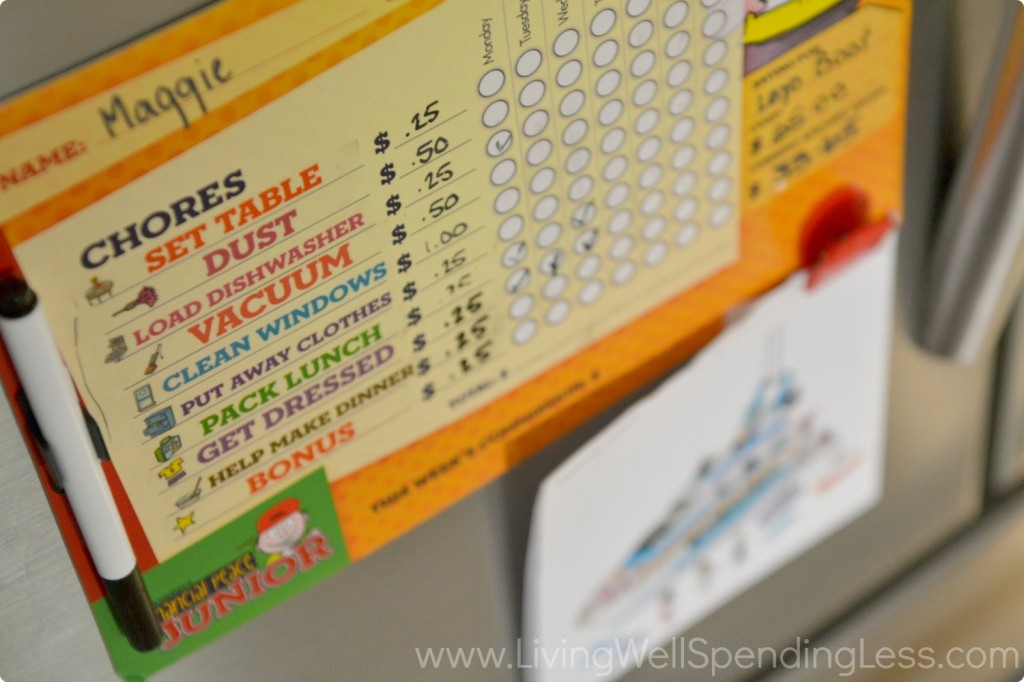
Posting a chore chart on the fridge helps kids track their allowance earnings.

1. Money Comes From Work

It is pretty scary to realize that most kids these days—and even many parents—don’t understand this very basic concept. Dave and Rachel recommend setting up a commission system—where kids get paid for the work that they do—rather than offering them a weekly allowance. That commission then gets split into 3 separate envelopes—one to spend, one to save, and one to give.

We have set this up in my house, and let me just tell you, it works! The closer it gets to payday, the more enthusiastic my girls become about helping out around the house. They absolutely love filling the check marks in their chore chart, (we use the ones in this Financial Peace Jr. set) then counting up their money at the end of the week. Our payday happens on Sunday night so they have all weekend to boost their payout. Their chores and pay scale are based on their age—7-year-old Maggie has a few harder tasks that can earn more money, while 4-year-old Annie simply earns a quarter per checkmark.

2. When it is Gone, It’s Gone

Teaching kids that actions have consequences is a lesson that goes far beyond money. It is so hard to let your kids fail sometimes! Both my husband and I have a really hard time with this, especially when it comes to money. Rather than letting them make bad choices and then experience the consequence of that choice, we simply say, “no, you can’t buy that,” and all their money stays in the bank. After reading Smart Money, Smart Kids, I realized that we do need to let them experience the process of spending the money that they earn so that they can also learn that when it is gone, it is gone.

Adding money to your savings piggy bank can be fun!

3. It’s Okay to Wait

We live in a world of instant gratification, one that is becoming more so all the time, and there are sadly far too many kids who grow up thinking that if they want it, they should have it right now.

A few years ago, as the director of a large day spa, I saw this all too frequently with my entry-level front desk employees, who were mostly girls in their late teens and early 20s who thought working at a spa would be glamorous and easy. I can’t even tell you the number of times one would ask for a raise after just a week—or sometimes even a few days–of work. They had been so accustomed to being rewarded for nothing, they had no concept of delayed gratification. It was sad, and as an employer, extremely frustrating!

DIG DEEPER

We invite you to join more than one million subscribers in getting regular tips & advice via email. When you subscribe you’ll also get access to our game-changing Living Well Starter Guide as our gift to you!

Through their commission system, my own girls are slowly learning that it is okay to wait and save for the things they want. Right now they are each saving for a (ridiculously overpriced) Lego play set. $65.00 is a huge number when you are only earning $0.25 at a time, but they are both doing great. Each week they get a little closer to their goals, and each week they become a little more motivated to work harder. I’m pretty sure I will cry the day we finally get to go to Target with their jar full of money to pick out the toy they worked so hard for!

4. It’s Not All About You

Not long ago I was stopped in my tracks by one simple but life-changing question:  What are you doing with God’s money? As a Christian, I believe that what I have is not my own. It is a responsibility I take seriously. I am called to be a good steward of the resources I’ve been given, and just importantly, I am called to teach my children to do the same.

But in all honesty, this calling is not a burden. There is no greater joy than teaching my kids how to give! We do this in lots of different ways, especially at Christmas, and our favorite ways to give are with our time, not our money. Even so, it is important that my kids understand that they money they earn needs to be shared.

Each week, at payday, they first put a portion aside to put in their give envelope. They get to decide how much they will give, and they also get to pick the recipient, since at this point we are far less concerned with who they give to than that they experience the joy of giving. I’m sure our giving plan will evolve and adapt as they get older, but it will always be an important part of their financial education.

Help kids set aside money to give and place it in a special wallet, like this cute clear giving pouch.

5. Tell Your Money Where to Go

Right now our primary focus is teaching our kids the basic concept that money comes from work. Even so, by teaching them to divide their money each week into their spend, save, and give envelopes, we are also trying to set the foundation for learning how to budget their money. We want them to learn while they are very young that if you don’t tell your money where to go, it will go away. It is a concept I wish I would have learned much earlier in life!

While the envelope system works great for younger kids, older kids need to be given even more responsibility for their own budgets. By the time they are teenagers, kids should know what their main expenses are–everything from entertainment & activities to clothing, food, and savings–and how to create a simple budget each month to make sure they are living within their means. (There are some fantastic tips for exactly how to set this up in Smart Money, Smart Kids.)

6. Don’t Buy Things You Can’t Afford

In today’s society, our instant gratification mentality has also transferred to our wallets, where we buy things we can’t afford with credit cards so that we can have them right now. Teaching my kids that credit is not the answer means that I have to be willing to live by this philosophy too. After all, if they see me buying whatever I want, regardless of my ability to pay, my warnings not to use a credit card won’t mean a whole lot, especially as they get older. Instead, our goal is to model for them a cash budget system, one where we save for the things we really want just like they do.

As they get older, they will have to learn how to save for bigger things like college or their first car. While car payments and student loans have become the norm, they shouldn’t be. Kids today are graduating from college saddled with huge debts that in many cases could have been avoided with more planning and better choices. We are determined to not let our kids become a statistic by teaching them now that credit is not the answer.

There are two ways to be rich: One is to have everything you want; the other is to want everything you have.

7. Choose Contentment

While all this other stuff is important, helping my kids learn to live with a spirit of contentment is by far the most important lesson I will ever teach them. A wise person once said that there are two ways to be rich—one is to have everything you want, and the other is to be satisfied with what you have.

At our house we call this our “Attitude of Gratitude,” and it is a subject that comes up a lot, especially when my kids start to get whiney or entitled. Last month, for instance, we decided to surprise the girls and two friends with a visit to Disney on Ice, which was touring nearby. As we walked into the arena, they were positively giddy with excitement. Until, of course, they spotted all the light-up wands, cotton candy, stuffed toys, and other assorted trinkets for sale. Their attitudes instantly shifted from excitement to longing. After listening to several rounds of “please, please, pleeeeaaase can we have that Mommy,” we gently encouraged them to list all the things they were experiencing (getting to see princesses, having a fun sleepover with friends, etc.), rather than focusing on things we weren’t buying. It completely changed their perspective, and we all had a great time. (And just in case you are wondering, yes, my husband and I sometimes have to remind each other of this too!)

Choosing contentment is a daily battle and a choice I have to make right alongside my kids. It means choosing to count our blessings rather than focus on what we don’t have. It means remembering to say thank-you, and to stop comparing. And it never, ever ends.

Posted in Financial freedom, money management, Parenting, teaching teens

Teaching kids about money: should parents or teachers take responsibility?

For most us, our relationship started with the humble piggy bank.

Into the ceramic swine went our pocket money and, occasionally, we were allowed to take it out for a new toy. That’s how we learned to save.

But what’s the point of a piggy bank when there’s no coins or notes to put in it?

Joanne McGee is a mum of two girls, Megan, aged six, and Tilly, aged four, and is just starting to teaching kids about money.

“The value of money needs to be taught a bit more about, I think, but that’s quite hard, especially as today we don’t see much physical money.

My girls see me shopping but I’m just handing over my card, or on the internet clicking on a button.”

She isn’t alone: 2017 saw card payments overtake cash – but at least most parents understand how a debit card works.

Brooklyn Andrew (pictured) is a mum of three and assistant secretary for her local branch of Foresters Friendly Society.

Her oldest child, Keane (pictured right), aged 8, recently started playing cult online game Fortnite, where players use a virtual currency, V-Bucks to buy virtual weapons and outfits.

The problem is, you buy V-Bucks using real money.

“To buy them he’s using my card and I found it quite a struggle to explain to him the difference between that and having the money in bank accounts and physical money”, says Brooklyn.

“I wouldn’t have a clue what to teach them because it’s not something I do myself.”

A gap in the classroom

With money changing so rapidly these days, it’s understandable that mum and dad don’t always have the answers.

The problem is, neither do school teachers.

A study by financial advisers OneFamily found that more than one in three parents struggled to discuss money with their children.

55% of secondary school teachers also believe there is not enough focus on preparing teens to manage their own finances.

Yet a similar proportion, 50%, rated their own school’s Personal, Social, Health and Economic (PSHE) education as satisfactory or poor.

A fifth of teachers surveyed said they only did the minimum required to tick a box, whilst 41% said the resources available to teach teens about personal finance were out of date.

Teachers said they were already observing the repercussions of limited financial education.

Many of their teenage students had unrealistic expectations of what they’d earn (observed by 45% of teachers), didn’t know the difference between a credit and debit card (38%) and some didn’t even know where money comes from (16%), according to OneFamily’s study.

Counting money vs. understanding money

So, what are children being taught about money in schools?

Personal finance is covered by three subjects: maths, citizenship and PSHE.

Citizenship is intended to deliver practical information: for example, children in Key Stage 4 (aged 14-16) learn about “income and expenditure, credit and debt, insurance, savings and pensions, financial products and services, and how public money is raised and spent.”

PSHE takes an even-more ‘real-world’ look at personal finance.

As the PSHE Association of teachers explains, “mathematics lessons can teach pupils to calculate interest rates but in PSHE lessons pupils develop and use critical thinking and risk assessment skills to evaluate whether, for example, having a card with sufficient credit to pay for something is the same as actually being able to afford it.”

It’s not clear, however, whether most children follow the citizenship or PSHE curriculums to the letter.

Schools are not legally required to teach the personal finance parts of PSHE, despite the Commons Education Committee calling for PSHE education to be statutory back in 2015.

Although citizenship education is mandatory to age 16, just 1% of pupils took the GCSE in citizenship in 2018.

With schools’ budgets being cut by 8% since 2010, and pressure to prioritise exams and grades, the sorry state of money teaching is understandable, but children are the ones losing out.

Should parents do more?

To make up the gap between teaching and reality, five in six teachers say that parents should do more.

Parents aren’t necessarily opposed: mother-of-two McGee says responsibility for teaching money should be divided equally, whilst Andrew says parents should take the lead: “you’re spending more time with them; it’s you taking them out shopping; it’s you who they see day-in-day-out, when you have to work budgets out and things like that”

The PSHE Association also advises that “ideally many of the topics covered in PSHE are a partnership between parents and schools. It’s not always guaranteed though, which is why schools should cover it as standard.”

Parents shouldn’t be put off teaching their children about money, says Steve Ferrari, managing director of child trust funds at OneFamily.

“Official guidance recommends that parents start teaching their children about money when they are a toddler and it doesn’t have to be taxing or complicated.”

Ferrari recommends that you start giving pocket money at age 6-7 to show them the benefit of saving.

If you need help with pocket money take a look at this article by love MONEY journalist Felicity Hannah, herself a mum, who asked a panel of financial experts for their pocket money tips.

When children are a bit older, it’s time to consider getting them their own bank account.

Many high street banks offer accounts, cash cards and debit cards to those aged 11 or above. There’s also a range of budgeting apps aimed at young people.

If you want to save for your child for the long term, you should consider a Junior ISA, which they’ll only get access to once they’re 18.

Growing up quicker than ever

Parents have always worried about their children squandering money, but the next few years could be particularly risky.

September next year will see thousands of teenagers born in 2002 receive access to their Child Trust Funds.

Launched by the New Labour Government, and discontinued in 2011, these were worth £250 (or £500 for low-income families) and many have since grown in size after being invested.

Where the money goes, criminals follow.

The Financial Conduct Authority has already warned that under 25s are six times more likely to trust an investment offer made via social media than over 55s, the group usually targeted by scams.

In some cases, Instagram ‘influencers’ impress young people with images of cars and jewellery, whilst persuading them to invest in highly risky investments such as cryptocurrencies.

Parents need schools to go beyond teaching children to add-up coins and address these all-too-modern threats. But with PSHE education still not mandatory, many children will miss out.

Teaching money at school has one final advantage, of which older generations are acutely aware.

A few well-spent hours in a classroom could reduce the need for a lifetime of learning through mistakes, sometimes at great expense.

As McGee reflects “I would have liked to have learnt about interest rates and mortgages…because that’s what real life is about really”.

Posted in Financial freedom, money management, Parenting, teaching teens

Creative Ways to Teach Kids About Money

You can use toys like a toy cash register to teach your child a valuable lesson. For instance, learning how good it feels to give and what a positive impact it can have on other people’s lives is a great lesson for little ones. As is the fact that if they save money rather than spending it now they might miss out on some of the instant gratifications but they end up getting something much better in the end. You could even focus on financial education for kids by adding to their savings jar, perhaps every time they don’t dip into it for a month.

Let them choose how they split the money as this is part of the lesson. This is a great way to learn about money management and can start at any age.

Introduce money when they play

Adding a toy till to your toy box can be a great way to get little kids thinking about the concept of money, you can have conversations about how much things cost, and they will also be learning maths at the same time.

You can also play a money matching game to help them learn to recognise the different denominations of notes and coins. Little ones don’t understand to begin with that they need 100 pennies to get a single pound coin but it’s a good lesson for them to learn.

You can also get them to use real money either at home to “buy” their treats, or when you are out shopping. Give them a list in the supermarket and get them to see how little they can spend while still having everything on the list.

Talk about money in front of your kids

Ok, this isn’t exactly creative but there are many many people who don’t talk about money in front of their children. Kids learn by seeing us modelling behaviour, good or bad, so let them see you pay the bills, and bring them in on conversations about money. It’s good for them to understand that if money is spent on one thing it won’t be there to spend on something else.

Just be aware of your own relationship with money and work on it if you need to. You don’t want to pass on negative feelings about money or bad habits to your kids.

Posted in Discipline in kids, Financial freedom, Kids, money management, teaching teens

Are You Financially Literate? – Tips & Resources to Boost Your Money Smarts

Financial education for kids and for everyone is a big deal. In the United States, it’s among roughly 60 official month-long observances declared by presidential proclamation.

Just as February is Black History Month, May is Mental Health Awareness Month, and November is National Entrepreneurship Month, April is National Financial Literacy Month. In the wake of the global financial crisis of the late 2000s, and following years of unofficial observation and multiple state-level declarations, President Barack Obama formally recognized April as Financial Literacy Month in 2011.

Why did the federal government feel the need to devote 30 whole days to financial literacy programming? For starters, because financial illiteracy is expensive. In a 2019 study by the National Financial Educators Council, the self-reported cost of deficient personal finance knowledge in 2018 was $1,230 per respondent. That’s about 2% of the 2017 median household income.

If you feel like an incomplete understanding of basic personal finance concepts cost you last year, you’re clearly not alone. But financial literacy isn’t rocket science. With effort, you can overcome whatever knowledge gaps you face today and cease leaving money on the table. Start here.

What Is Financial Literacy?

“Financial literacy” describes the knowledge and skills necessary to effectively manage your personal finances and achieve complete financial self-sufficiency.

Financially literate consumers are equipped to make informed financial decisions about a host of money-related matters, such as:

  • Banking
  • Near-term budgeting
  • Using and managing credit and debt
  • Avoiding financial scams and exploitation
  • Setting and saving for financial goals
  • Long-term financial planning
  • Investing
  • Estate planning

Like language literacy, where your reading grade level quantifies your competency, financial literacy is gradated. Novices have little to no understanding of even the most basic financial concepts. Intermediates grasp the basics of spending and saving but may struggle with more abstract or longer-term concepts. Experts have the knowledge and confidence to manage all aspects of their financial lives and equip others – kids, parents, domestic partners, friends, employees – to do the same.

How to Increase Your Financial Literacy

No one is born with expert-level financial literacy, and no one achieves it overnight. But that’s not to say that becoming financially self-sufficient requires years of intensive study – far from it. Here’s what you can do, right now, to begin or advance your own personal finance journey.

1. Know Yourself

The first step on your journey toward financial literacy is self-knowledge.

Yes, as your financial and personal circumstances change, so will your principles, objectives, and priorities. But that shouldn’t deter you from establishing a frame of reference in the here and now. Among other things, consider:

  • Your Time Horizon. What stage of life are you in? Younger consumers’ priorities naturally differ from older consumers’.
  • Personal Values. Consider any deeply held beliefs or values that may affect your financial behaviors. Some consumers aim to avoid debt at all costs, for instance. Others orient financial decisions around environmentalism, precluding luxuries like car ownership.
  • Goals and Objectives. What are you spending and saving for? Where do you want to be in five, 10, 20 years?
  • Risk Tolerance. Use a risk tolerance assessment to inform your investing decisions beforeyou begin putting your money to work. The University of Missouri’s risk tolerance questionnaire is one of many examples.
  • Credit Profile. Even if you suspect you don’t have much of a credit history, find out for sure. Go to AnnualCreditReport.com to claim the free credit reports you’re entitled to by law, then use a free service such as Credit Karma to periodically check your credit score and learn how to improve it.

This is just the start. As your financial literacy improves, you’ll gain more insight into who you are as a consumer, planner, and investor.

2. Always Consider the Source of Financial Information & Advice

Financial literacy requires voracious information consumption. Alas, not all financial information and advice is equally valuable. Alwaysconsider the source of anyfinancial information you consume, including information published on personal finance blogs like Money Crashers. Yes, we strive to be unbiased and informative, but our content is written by a diverse roster of authors with diverse credentials, whose writing is informed by a combination of in-depth research and personal experience. Always consider information in light of its applicability to your situation and goals. The same goes for any personal finance website, publication, or podcast, no matter how authoritative it purports to be.

Be particularly wary of financial content from profit-driven financial companies, such as banks, investment firms, and credit repair agencies. For profit-driven organizations, publishing unbiased advice is secondary to selling their core products and services. They’re in thecontent marketing business, meaning their content is valuable to them only insofar as it increases their credibility in the marketplace.

Also be wary of what’s often referred to as the “financial entertainment complex.” Cutthroat competition drives financial entertainment outlets like CNBC and Motley Fool to promote controversial, contrarian ideas at the expense of sounder – if less sensational – viewpoints. Despite obligatory disclaimers, financial entertainment outlets may present as mainstream investing recommendations that aren’t suitable for most readers or viewers, with potentially adverse consequences for those who take them as gospel.

At Money Crashers, we put the fundamentals of financial fitness before all else and take a balanced, comprehensive approach to describing personal finance concepts and strategies. By contrast, sourcing information only from financial entertainment platforms – watching CNBC all day, for instance – is a sure way to distort your financial worldview.

When in doubt, turn to neutral, reputable sources, especially official government agencies such as the Consumer Financial Protection Bureau and Securities and Exchange Commission, and nonprofit research universities.

3. Seek a Range of Opinions & Advice

Always seek an assortment of opinions and advice about money matters. You wouldn’t opt to undergo major surgery on the recommendation of the first doctor in the phone book; why would you make a potentially life-changing financial decision on the basis of a single article or video?

By exposing yourself to a range of financial philosophies over time, you’ll gain the perspective necessary to sort valuable information and advice from bunk and the confidence necessary to articulate your own financial philosophy.

4. Master the Fundamentals

Turn to unbiased resources, including Money Crashers, to learn about foundational concepts such as compound interest, bank account types, account fees, deposit insurance, investment diversification, and the time value of money. The distinction between checking and savings accounts isn’t the most gripping topic, but every banking customer needs to understand it to avoid, say, excess withdrawal penalties for exceeding the six-withdrawal-per-month limit to which all U.S. savings accounts are bound.

5. Take Classes or Courses

Look for free or cheap personal finance classes and courses that you can take in your spare time. Brigham Young University, a private higher education institution based in Utah, has a pretty robust – and free – online personal finance education vertical, for instance. Indiana-based Purdue University has a retirement-focused course applicable to a range of financial situations. If you prefer in-person instruction, your local community college or library might have free or cheap evening or weekend classes.

6. Use Free or Low-Cost Money & Credit Management Tools

In addition to Credit Karma, Credit Sesame is another great free credit monitoring resource. As long as you can tolerate periodic offers for paid products and services from their partners, there’s really no reason notto opt into a free credit monitoring service.

It’s also wise to use a free or low-cost personal budgeting app, particularly if you’ve had trouble sticking to your budget in the past or you haven’t ever had a real budget. Mint is a popular, user-friendly option that doesn’t cost anything out of pocket; NeoBudget is a no-frills digital take on the cash-based envelope budgeting method; You Need a Budget claims its bells and whistles save the average user $6,000 per year; and if you love Google Sheets you can do your budgeting through Tiller.

Finally, consider an automated savings app – again, particularly if you’ve had trouble maintaining a steady savings rate in the past or saving at all. This space is crowded too; start by checking out Chime, which – unlike some automated savings solutions – has no monthly maintenance fees or hidden fees. Acorns is another to consider. When they round up your purchases, the difference is invested into an investment portfolio that you set up based on your risk tolerance.

7. Don’t Try to Walk Before You Can Crawl

Never overestimate your financial literacy. If you’re struggling to understand a particular financial product or behavior and can’t find easy, unbiased answers, steer clear until you feel more comfortable. For example, don’t open a margin account and start day trading before you understand how equity markets work; that’s a recipe for financial disaster. Instead, you can use a robo-advisor like Betterment, and they will handle most of the work for you.

8. Don’t Be Afraid to Ask for Help

Rather than overestimate your financial literacy, seek guidance from people and organizations that know more than you.

Use the Financial Planning Association’s free planner search tool to find Certified Financial Planners aligned with your goals and set up no-obligation consultations with each, even if you’re not yet ready to make a plan or hire an investment advisor.

If you’re struggling to pay down debt, use the U.S. Department of Justice’s list of approved credit counseling agencies by state to find reputable providers in your area.

If you’re preparing to buy a house or want to know what the process entails, look for a HUD-approved housing counseling organization and enroll in a class.

Just remember: Don’t take the word of any one person or organization as gospel. As in investing, the key to success in building financial literacy is diversification.

Posted in money management, Parenting, teaching teens

8 Financial Tips for College Students to Save and Manage Money Better

If your child is one of the millions of college freshmen headed off to school, your August might be packed with shopping, gathering textbooks, and packing up entire rooms. And while picking out the perfect dorm decor might seem important, don’t neglect the deeper subjects.

Now is the time to talk to your child about personal finance. As a parent, you have the opportunity and obligation to prep your freshman on budgeting and smart spending strategies before he or she hits campus.

While college students might roll their eyes at the idea of making a budget, you being a parent should focus on financial education for kids that is vital to the college experience. Whether your child is paying his or her own way, receiving your help, using financial aid, or a little of all three, college is an expensive experience that becomes pricier with poor spending practices. By passing on a few words of wisdom, you can give your freshman the tools he or she needs to start college on the right financial foot.

Personal Finance Tips for College

1. Create a Budget

Carefree high school students frequently spend whatever is in their bank account, living off their parents’ generosity or the spoils of a part-time job. Once that student moves away to college, a budget becomes crucial.

Whether or not your child has been exposed to a budget, it’s important that you sit down together to look at finances. Map out his or her various streams of income, including money you’ll provide, income from a job, and money coming from student loans, grants, and other types of financial aid. Then, show your college freshman how to categorize expenses so he or she knows where it’s all going. While you can’t force your student to stick to a budget, you can feel confident he or she knows how to use one and has a clear picture of what is and isn’t affordable.

As stated, the trick with any budget is sticking to it. Once you and your child have gone over the budget, take some time to talk about how to make smart money choices that fall within the budget. For instance, help him or her navigate free or low-cost social activities, such as outdoor concerts, city-sponsored events, or school-sponsored adventure trips. You know your child better than anyone, so if he or she loves spending money on cappuccinos or the latest designer clothes, take some time to talk about buying clothes from discount retailers or brewing joe at home. Encourage him or her to track recurring expenses in a paper planner or digital calendar app to determine which makes more sense for your child.

While it’s tempting take over your child’s finances, let him or her lead – after all, it’s time for your college student to manage a budget. You can check in to make sure that he or she is on track, but let your freshman remain in charge.

Personal Finance Tips

2. Use Online Services

College students aren’t likely to sit down and go over finances in an Excel spreadsheet – especially when there are better options available. Instead, set your student up with an online service or smartphone app that makes money management easy and convenient. After all, that smartphone is practically glued to his or her hand anyway.

Some apps, such as Mint, make money management easier for a busy or forgetful college student. Mint enables users to upload bank account and expense information so he or she can manage all of his or her accounts in one place. The app makes budgeting a little more accessible for a college coed who is busy and on-the-go. This ensures fewer missed payments and penalties, as well as easy access to account balances.

In addition to money management apps, make sure you also take the time to set your student up with online banking services so he or she can transfer money online or use mobile deposit.

3. Minimize Student Debt

There are several ways to minimize student debt. Make sure you cover all the bases before sending your freshman off to school.

  • Spend on the Right Things. Naturally, college students shouldn’t use financial aid to fund pizza night in their dorm rooms, but temptation is a powerful thing. Take the time to impress the importance of using debt wisely. Even if loans look like “free money” now, they do come back to bite you. It’s your job as a parent to define what is and isn’t okay for your child to use loan money for. Tuition, books, housing, and maybe food plans – not social outings, new clothes, or pitching in for a party keg.
  • Borrow Only What’s Required. Not every student heads off to school with a fully-funded college trust. If your child needs to take out student loans, remind him or her that the amount borrowed should be commensurate with the type of salary available once a degree is obtained. Even if your student does choose to borrow money for school, it should be for school. Taking out more cash to fund an extravagant campus lifestyle might seem important now, but could be a serious problem later. Freshmen should start a pattern of living frugally now so that they’re not paying interest on things like a bigger dorm room or fraternity fees later.
  • Fund Extras with a Job. If your coed wants to fund a social life, it should be done with a part-time job, rather than student loans. Work-study positions usually offer the flexibility a student needs with the convenience of location, while off-campus positions frequently pay more. Either way, teach your child to have a “pay now” policy for nonessential purchases so that he or she doesn’t really pay for them later.
  • Funnel Extra Earnings to Loan Payments. Try to add extra loan payments into your child’s budget by using funds from a part-time job or from monetary gifts to help pay down student debt. While loans technically aren’t due until after graduation, paying them off while in school can help your student save serious money when it comes to long-term interest.

4. Look for Student Discounts

College students should become masters at exploring the ways their educational status can save them money. Vendors, local venues, restaurants, and services near college campuses often offer student discounts that could save your freshman big money during the first year. What’s more, by looking for discounts, students learn the value of hunting down great deals.

5. Take Care With Credit Cards

If going to college is like setting sail in a vast ocean, then credit card companies are the sharks. They specifically prey on new and inexperienced freshmen, banking on the notion that freshmen are strapped for cash and excited about the prospect of “easy” money. They also expect freshmen to be careless with credit cards, racking up late fees and high interest payments. Credit card companies often lure students in with college-centric offers, such as the promise of free concert tickets or free college swag.

Make a rule with your freshman: If he or she wants a credit card, the two of you can choose the best one together. Freshmen should never sign up for a student credit card on a whim. Instead, you can talk about the pros and cons of different cards, set a reasonably low spending limit, and look for cards with points or cash back rewards.

Your child may also want to use a debit card while in college. While it sounds foolproof, make sure your student’s bank doesn’t allow a large overdraft. In fact, turn off overdraft protection so your student can only spend what he or she has in the bank and won’t get slammed with overdraft fees. You can prep your child by setting him or her up with a prepaid debit card at home – he or she will soon learn that when the money is gone, it’s gone.

6. Set Financial Limits

One way to help your child curb first-year spending is to propose financial limits for unnecessary items. Setting a spending limit doesn’t necessarily prevent your freshman from making impulse purchases, but it should give him or her pause to assess whether or not the new iPhone is really necessary. By setting a fairly low limit – say, $50 to $100 per month – he or she has some wiggle room without having carte blanche when it comes to spending power. Add the nonessential money into your student’s proposed budget, separate from essential expenses such as gas and food.

While you can’t spend your time hanging over your student’s shoulder, making sure he or she is sticking to the plan, you can remind him or her of its importance. If possible, you can also help lighten the load – if you know your student is strapped for cash and you have the means, send a care package with nonperishable food or a prepaid gas card to campus.

Set Financial Limits

7. Avoid Full-Price Textbooks

Ah, the textbook – the budget-breaker of college students everywhere. While it’s true that some professors change and update texts practically every year, the vast majority use the same textbooks year after year. That means your student shouldn’t have to shell out hundreds to shop for books before class.

There are lots of ways your student can save money on college textbooks, such as searching for posts on campus bulletins, or shopping at eBay and Amazon. Or, have your child check out websites such as Chegg, where many common textbooks are available for rent. Some schools also offer textbook rental programs, so ask the bookstore and library about the options that are available.

Unless it’s absolutely necessary, steer your student away from the campus bookstore, where prices are likely to be the highest. Also, be aware that some professors add “suggested materials” to the book list, many of which may not be necessary for passing the class. Help your child look over his or her syllabus to weed out the necessary texts from the suggested ones.

When the school year is done, suggest that your student sell used textbooks to others who need them the following semester. School bookstores, online book retailers, and social media sites are all good places to advertise textbooks for sale. Your student can recoup some of the cash spent on buying books, making it available to pay down student loans, pay off credit card debt, or add to savings for next semester.

8. Protect Personal Information

When it comes to identity theft, college students are some of the hardest hit and the most oblivious to the crime. According to Javelin Strategy and Research, the 18 to 24 demographic has the highest risk for identity theft. Not only that, but the average individual from that demographic took 132 days to detect and report the fraud.

Caution your student not to share personal information. Simple things like giving a password to a friend, providing Social Security numbers where unnecessary, or leaving personal documents lying around, can all open your child up to identity theft.

To catch theft before it goes too far, students should check bank and credit accounts regularly, reporting any suspicious activity immediately. While identity watch services are available, the monthly fees may not fit into a college student’s budget. Instead, teach your child to pay attention to his or her accounts and suggest he or she order a free yearly credit report from all three of the reporting bureaus through AnnualCreditReport.com. There is, however, an argument for an identity security service such as LifeLock if your student thinks his or her identity has already been compromised.

It’s an unfortunate drawback to college life, but if vigilant, it doesn’t need to color your freshman’s first-year college experience.

Final Word

When you send your freshman off to college, you’re not just ushering in a new era for your family, you’re also looking to see whether all the advice and financial training you’ve given your child really pays off. Nobody always makes perfect financial decisions, but if you’ve laid out a solid foundation of training, your child should make it through the first year without making too many financial mistakes.

Posted in Discipline in kids, Financial freedom, Kids, money management, Parenting

How to Home-School Your Child on a Budget & Save Money

A nationwide survey by USA Today found that, due to the COVID-19 pandemic, 60% of parents polled are considering home schooling instead of sending their kids back this fall, with one-third saying they’re “very likely” to keep their kids home.

Home schooling can be an excellent way to give your child a diverse and interesting education and to provide them the education they will never get in school, you can simply focus on teaching kids about money which will surely help them in longer run . It can also get expensive if you’re not careful. There’s the cost of a curriculum (that may or may not work for your kids), materials, books, and extracurricular activities. You might also have to factor in the cost of transitioning to a one-income household so one parent is home to teach.Sign up for a BBVA Online Checking account by 8/21/2020 and get up to a $250 bonus and no monthly fees.

There are many pros and cons to home-schooling your kids. And there are also many ways to give your kids an enriching education at home on a tight budget.

How Home Schooling Can Save Money

It’s true that home schooling has some upfront costs not found in public school education. However, there are also many ways home schooling can be cheaper than public school, especially when you look at just how expensive public school is.

According to Huntington Bank’s yearly Backpack Index, in 2019, parents paid the following amounts to send their child back to school:

  • $1,017 for elementary school supplies, including extracurricular fees and technology
  • $1,277 for middle school supplies, including extracurricular fees and technology
  • $1,668 for high school supplies, including extracurricular fees and technology

Public school is supposed to be free education, but the reality is that sending your kids to school is expensive. And there are many reasons home schooling can be less so.

School Supplies Back Pack Scissor Pens Pencils Notebook

Clothes & Accessories

According to the National Retail Federation, the average parent spent almost $240 per child on back-to-school clothes in 2019. That’s a lot of money. Sure, kids will always need new clothes, but many want particular styles and designers because that’s what their friends at school are wearing.

Home-schooled kids aren’t subject to the cliques and peer pressure often found in public schools. They can go to school in their pajamas if they want to. So you’ll likely spend less on clothes and shoes for your home-schoolers. You also won’t have to buy backpacks and lunchboxes.

Supplies

According to NPR, each year, teachers spend an average of $300 to $1,000 or more of their own money to buy supplies for their classroom thanks to school underfunding. Often, teachers have no choice but to ask parents to chip in for general-use items like tissues, craft supplies, and hand sanitizer. And these expenses add up.

Your local public school may or may not ask you to chip in for general classroom items, but as schools continue to struggle with financing, there’s a decent chance they will. With home schooling, you’ll still need to purchase some of these items for your own home, but you won’t have to buy them for a whole classroom of kids.

Medical Expenses

Every parent dreads the onset of cold and flu season because their kids will catch something at school and bring it home for everyone else in the house to enjoy. With COVID-19 still widely circulating, the classroom’s close quarters are an even more significant concern, despite social distancing guidelines.

Home-schooled kids aren’t exposed to the bacteria and viruses that make their way through a classroom each winter, making it easier to avoid the flu and other infections entirely. You save money on doctor visits, medication, and lost time at work or school.

Food

According to NBC News, the average cost of a school lunch is between $2.70 and $3.10 per child per day. If you have two children attending public school and their lunch is $3 each, you’re spending $30 per week on school lunches. When you home-school, you can dramatically reduce this cost and eat healthy on a budget.

You’ll also save on classroom snacks. Many teachers ask parents to provide a packaged snack for the class once per month, and buying snacks for an extra 25 to 30 kids can add up.

Vacations

Home schooling can also help you save money on family vacations. When you home-school, you have a flexible schedule. You can vacation during the off-season and take advantage of drastically reduced rates on hotels, airfare, and entertainment tickets.

You can also turn those vacations into valuable learning opportunities for your kids, making them part of the school day.

Fundraisers

It’s likely all parents groaned collectively at this item. The school fundraiser is supposed to do two good things: give kids a taste of entrepreneurship and help the school raise money.

In reality, fundraisers often pit kids against each other in a popularity contest, and parents end up doing the majority of the selling on their kid’s behalf. That usually includes shelling out some of their own money on high-calorie chocolate or stale popcorn to get some additional names on the donor list.

With home schooling, there’s no fundraising involved.


How to Save Money Home Schooling

One of the most significant benefits of home schooling is that it’s so flexible. You can spend as much or as little as you want. And there are plenty of ways to give your kids a comprehensive education without breaking the bank.

Woman Happy Holding Cash Money Excited

Read, Read, Read

One of the best ways to save money home-schooling is to learn everything you can about it before you get started. Many home-schooling parents admit their first year was disorganized, hectic, and expensive because they simply didn’t know what they were doing.

Plenty of publications can help shorten the learning curve and save you from making expensive mistakes. Books like “Homeschooling for Dummies” by Jennifer Kaufeld and “Homeschooling 101” by Erica Arndt are a quick and informative way to quickly learn about home schooling, including how to abide by the legal requirements for your state. You can also find in-depth information on each state’s legalities at the Home School Legal Defense Association. The book “Home Learning Year by Year” by Rebecca Rupp can help you design a curriculum.

And check out “The Brave Learner” by Julie Bogart and “The Call of the Wild and Free” by Ainsley Arment, both of which are full of ideas and inspiration for instilling a love of learning in your children and making learning at home an enchanting experience for everyone. Both of these books will encourage and empower you — as a parent and teacher — to trust your instincts and believe in yourself.

Consider subscribing to home-schooling magazines like The Old Schoolhouse, Home School Life, or Homeschooling Today. These publications provide a wealth of tips and ideas for how to save money. Some conduct in-depth curriculum reviews that can help you avoid a pricey purchase that doesn’t work for your family. You can also visit Homeschool.com to read user reviews of many curricula currently on the market.

Find Resources Online

The Internet is a treasure trove for home-schooling parents looking for ideas to help build their curriculum. There are hundreds of sites that offer free printable resources for kids of all ages. A simple search can yield worksheets, coloring pages, craft ideas, and games.

  • KhanAcademy is one of the most popular programs for home-schoolers. With classes and curriculum for K-12 students, Khan uses interactive programs and video clips to make learning fun. It also provides SAT, MCAT, and GMAT test prep.
  • Starfall is an interactive reading website geared toward early learners, particularly preschoolers and early elementary school students. Kids can start by learning their ABCs and progress up to reading.
  • ClickSchooling sends out free web-based curriculum ideas every day, each with a different theme (for example, Monday is math, Tuesday is science, Wednesday is language arts).
  • Easy Peasy All-In-One Homeschool is a free Christian-based home-school curriculum.
  • Only Passionate Curiosity puts together a comprehensive list of free curriculums and resources organized by subject, providing hundreds of free resources.
  • EdHelper.com offers free printable worksheets and posters for pre-K through high school.
  • Emotional ABCs is a free research-based program to help kids aged 4 to 11 learn more about their emotions and how to manage them.
  • KidLitTV has a wide variety of free online TV and radio shows to help inspire kids, from read-alouds to drawing classes to storytime.

For a low fee, subscription sites can give you access to even more educational resources. Many companies are offering free or reduced-rate packages due to the COVID-19 pandemic, so be on the lookout for these special deals.

  • Enchanted Learning offers more than 30,000 pages of learning material for students from pre-K through 12th grade. You can use the site to teach your kids about everything from art to zoology for $20 per year.
  • Time4Learning provides educational games to improve your child’s understanding of science, reading, math, and social studies. They also have a curriculum available for each grade level from pre-K through 12th grade. The cost is $19.95 for kindergarten through eighth grade and $30 per month for high school students.
  • Reading Eggs focuses exclusively on reading skills. Children ages 2 through 13 can use games and interactive lessons to start by learning their ABCs and progress up to reading. There’s a free 30-day trial. After that, access costs $59 for 12 months for one child and $89 annually for two to four children.
  • ABCya has many free educational games on their websites for kids aged pre-K through 6th grade. The site offers some games for free, and you can gain access to all games through a monthly subscription of $9.99, $7.95 per month for six months, or $5.83 per month for one year.

Older students can get a jump-start on college prep through OpenCourseWare (OCW) programs at participating colleges and universities. Some of these companies are also offering free or reduced-rate packages due to the pandemic.

  • Massachusetts Institute of Technology (MIT) offers a wonderful OCW program for older students interested in science and technology. Parents can also access the curriculum for free and use it as a guideline to teach everything from poetry to politics. Complete course materials — including lecture notes, handouts, and exam papers — are usually available at no cost to participating students.
  • Coursera offers free online college classes from universities like Stanford, University of Michigan, and Duke. World-renowned professors teach nearly every subject, making this an excellent platform for teens to start learning at the college level.
  • Carnegie Mellon CS Academy is a world-class free high school computer science course offered by Carnegie Mellon University.
  • Academic Earth offers free advanced-level courses on dozens of subjects from universities like Stanford, MIT, and Berkeley.

Our articles on keeping kids from regressing during school breaks and COVID-19 school closure resources for teachers have additional free and low-cost resources you can use in your home school.

Dive Into the Internet

A decade ago, there were only a handful of blogs about home schooling. Today, there are tens of thousands, if not more.

Home-schooling blogs provide a wealth of information from parents already in the trenches. These parents profile what works for them and what doesn’t, talk about where they’ve wasted money and which resources have helped them save a bundle, and provide much-needed advice and encouragement. Many compile link roundups full of free ideas and materials for home-schoolers.

Posted in Financial freedom, Kids, money management, Parenting, teaching teens

Teaching Children About Finances

Financial education for kids is a completely vital part of their upbringing in this contemporary age while it can be disastrous for young humans to be unable to deal with their budget nicely. It is very vital that children examine early that awful economic making plans can cause issues during their existence.

Children have to be introduced as much as recognize what money is and learn the benefits of saving and spending accurately. Here are some pointers that will help you to train your youngsters what cash is and how it can be each a blessing and an anvil around their necks relying upon how they take care of it.

A. Young Children

1. The Cost of Everyday Items

When children are able to depend, educate them the way to matter the usage of money. Teach them the distinction between the various coins and denominations of payments. Show them how tons of money they want for regular items: a Hershey bar, gum, pencils and different matters they use every day.

2. The Advantages of Saving

As they grow older, provide an explanation for how their allowance would no longer be enough to buy them something high priced, which include an eye, bracelet, football or their very own mobile phone, however in the event that they saved a certain quantity each week they may have the funds for what they desired after a time frame.

In different phrases, teach them what saving means and why they shouldn’t spend all their cash proper away. You should maintain a few allowances returned for them as ‘financial savings’ and pay them ‘interest’ in it, teaching your young kids how cash can grow if they don’t spend it immediately.

Three. Money as Earnings

Many households pay their children for sporting out chores. Washing dishes, tidying their rooms and helping mom with the shopping. Many regard this as a form of reverse blackmail – you do not get pocket cash unless you assist with the chores. You can triumph over that by means of giving them a simple weekly allowance, after which more according to the work they do for the duration of the week.

Those that do not paintings so tough will quickly see that their siblings that do are earning extra allowance then they may be. You can also ‘keep’ that more money for them, or a proportion of it, until college camp, the vacation period or to spend on their summer season vacation.

Including the saving aspect above, you can show them that through not spending $50 in their earnings, however saving it, they get $ fifty-five from you, or whatever seems an inexpensive interest fee. You would possibly even agree to suit what they shop so they in impact get a hundred% hobby.

Four. Explain Household Expenses: The “Cost of Living” Concept

Explain your own household fees in your kids once they have a rudimentary information of budgeting. Explain why you need to store for utility bills, hire or mortgage and insurances. How there are constant monetary commitments which include those, after which the regular expenditure on meals, apparel, tour and other prices. Let them remember the fact that the whole lot has a cost, and it’s far critical to have enough cash every month to satisfy the constant prices before you can take them to the cinema, ball sport or McDonald’s.

B. Older Children

Up until a positive age, you may have looked after your kid’s savings yourself, and exerted an excessive degree of manipulating over their spending. As your youngsters grow older and feature a rudimentary hold close of what cash is and how it can either be spent or saved until they have got enough for something they really want, you can train them the responsibility of searching after their own cash.

They will benefit an understanding of banking, investment and the importance of dwelling inside their manner – no longer spending extra than they make or get hold of. Here are some methods of coaching your older children, who are in effect teenagers, the importance of budgeting and using credit score well.

1. Open a Bank Account

Once they’re vintage enough, open a financial institution account for them. You can be responsible for maintaining it and will have to authorize their withdrawals until they reach a positive age, but through doing this you will make them experience ‘ growing up’ and liable for their very own cash – even if it’s miles a weekly allowance, or ‘pocket money’, paid into their account.

Explain the concept of hobby once more, and how they make cash by preserving their cash in the financial institution and now not spending it.

2. Make Them Responsible

When they want to make a withdrawal, by no means refuse, but speak it with them and subsequently comply with them making the withdrawal. If they spend all their money too fast, then that is as exact a lesson as saving all of it. Allow your children duty for their own cash, BUT – additionally, lead them to account if they spend it too soon.

This is particularly genuine if you have different youngsters who’ve saved for a weekend camp as an instance. They might be miffed in case you supply the spendthrift cash after they have saved up for it. That’s just an instance, but you get the idea!

3. Teach Budgeting

Take your kids shopping with you, and show them how a few items fee greater than others. If they want their very own portable DVD participant, display them the cost and relate that to their allowance – how a great deal so they should save for what number of weeks? Offer to fulfill a percent of the cost if they keep the rest.

Four. Explain How Credit Works

Show your youngsters your credit score playing cards and the way they paintings. Let them see you operate them in stores, and then display them the payments while they come in – that impresses on them that the whole thing should be paid for. Also display them the hobby price, and provide an explanation for this is the fee for borrowing money.

5. College and Credit Cards

It is critical that your kids grow up with a knowledge that credit fees money, but that every so often it is able to be worth it if the object bought is critical. Once your children are prepared for college, give an explanation for the significance of the use of credit cards simplest whilst necessary, except they have got sufficient saved to cover the monthly bill. Explain interest, expenses and what takes place in the event that they handiest pay the minimum amount.

Take some time on an ordinary foundation to speak about economic subjects with your children. You could have a fashionable meeting when you all discuss hobby rates for borrowing towards saving, and the specific methods they could shop. You could also observe that up with a private discussion with every one of your youngsters one by one regarding their personal finances. How an awful lot they have saved, and how much interest they’ve earned. Discuss how an awful lot it fees to borrow cash for things they want in comparison to the value in the event that they stored for them instead.

There are many approaches if you want to teach your youngsters approximately cash, household price range and how to look after their personal costs of an ordinary dwelling after they depart the nest. Whichever way you do it, you have to make sure for your own mind that your youngsters have at least an affordable understanding of the way to appearance after their own price range as a way to permit them to start out dwelling their personal lives with excellent historical past information of household budget and the relative advantages of borrowing and saving.

Posted in Kids, money management, Parenting, teaching teens

How to Teach Your Children about Savings and Value of Money

Teach the time value of money practically

Money is an important thing to discuss. People think that it is not worth discussing in front of children but in real fact, it is not a topic to avoid from the children. To make them saving worthy they should know the rules of finance and money.

Teach the difference between NEED and WANT

Children should be taught from an earlier age that NEED always comes to some steps forward than WANT.  The basic things that we can’t live without or living is hard, is the NEED. So at first always has to go to meet the NEEDS, then the meeting of WANTS is a bonus. These lessons help them all over their lives. It is very necessary to differentiate the NEED and WANT. Your children should have the ability to choose between a curriculum book or a game CD.

Help them to save by making an attractive arrangement

Children are fanatic of colorful or attractive arrangement. Think for a while, the child not fond of studying can suddenly love it if you give him or her a nice table made with favorite character drawn on it. The saving arrangement is also like that. If you arrange them making a piggy bank or others as their liking, the tendency for saving automatically arises.

Give some opportunities to them to earn

Earning just not comes with the pleasure, it comes with so many responsibilities, we have to remember that and help out children to remember that too. So give some scope for earning of their own. For example, you can give some household chores every day and give allowances against these. They can know the value of hard work behind earning the income.

cashmanagementbykids

Set a goal of saving for them

Then you can help them to spend and save those earning and unused pocket money. Just advising for saving is not enough to save. You can set a goal so that they would get interested to save like if they want to have a bicycle, ask them to save for this. Then they can be more encouraged ever than before to do hard work for getting a thing on the wanted list.

Managing cash is one of the effective ways of good financing

If you can’t do the cash management for the time value of money you can’t be a good cash manager. In real life, all of us are cash managers who deal with it continuously. For this, you have to track the income as well as the spending to maintain the present cost and saving.  After paying an allowance to the children, help them to keep track the earning and expenses by recording these.  By keeping records they can also think and make a decision that how many days they need to reach the particular saving goal.

Give the feel of borrower and lender 

You have set the goal, done the arrangement for saving, teach the cash management. Everything is fine. But things happen generally that your child is impatient of having his or her demand-able things. Then you may do one thing, borrow money with interest and tell that he or she can buy the things instantly but opt for a high amount of repayment as the saving is not enough.

kidssaving

The fact is that he or she has to pay the value of the impatience with the interest amount; otherwise the exact amount is enough to pay after meeting the saving goal. Thus they can learn about the patience of spending since childhood that they have to demand the things when they are ready for those Otherwise, things would be more costly.

Have the example of saving is a great way

Children learn by seeing things. They behave the way you behave. If you can show them your saving mentality, the interest in them can run on. So have a jar for the saved money and put money there every day, with the little contribution every day it will turn into a jackpot with time. Thus your children can have an interest in saving for the long term gain.

Communication about money

Most of the parents feel it unnecessary or fear of negative effect to communicate about the money. But it works so well beyond your imagination. To discuss money, its value, and talk about saving and investment, the advantages of saving for future profile and stress-free life.

Money apps for saving and investment

Teenage children can have a better option of technology to save money that is money-saving apps. For teaching teens about money these apps help to save and invest money according to different factors. These work by analyzing your saving behavior and goals. Some apps work just like the game so that the account holders enjoy the financing activities.

Various apps have brought distinct functions for the criteria of savings. You can download any of those on Android or iPhone and use those effectively.

Conclusion

Openly discuss the activity of money in human life, its honest and wise usage to have a secured life with all the enjoyment in all time.

Posted in Discipline in kids, Financial freedom, Kids, money management, Parenting

What Your Kids Need to Know About Money (And How to Teach Them)

As your kids grow, you teach them many different things–how to dress themselves, how to do their homework, how to ride a bike. Teaching kids about money is a process that can start when they are two or three years old and should continue until they reach independence as adults.

Getting Started

When kids are two or three, they will begin to notice that people use the money to buy things when they shop. Some kids may begin to want to buy things themselves, and you can help them by explaining what different coins are called and letting them pay for items when they are at the store with you.

Although kids this young won’t have much of a concept of how much a dollar or a quarter is worth, it’s not too young to give them a few very simple chores that they get paid a small amount of money to do. The sooner you can introduce the idea that money is something you get by working, the more ingrained that fundamental financial principle will be in their minds.

Building a Foundation

There are a few basic ideas about money that are important to teach kids of any age. The idea that money comes from work is important so that they understand you aren’t just going to give them money whenever they want to buy something.

Another important thing to teach kids about money is that it’s limited. Even kids in elementary school can understand it when you tell them you have a budget and you only have a certain amount of money to spend on an item because you need the rest of your money to pay the bills.

Saving money is another fundamental financial principle that is important for kids to understand as they grow. You can share your efforts at saving with your kids and show them that when the car breaks down or someone sprains an ankle, the money you saved can be used so that you can still afford to pay your other bills.

Each family has particular values around money that you can communicate to your child as they grow up–in fact, you probably will convey messages about money to your child even if you don’t intend to, which can be a negative thing if your own relationship to money is not entirely functional. Working on your own money management can be a gift to your child since they will tend to absorb lessons from your example whether it is a good one or not.

Should Kids Get an Allowance?

Most experts agree that giving kids an allowance is helpful in teaching them about money as they grow. Some feel that giving kids a certain amount of money, such as a dollar per week for each year of their age, is a good guideline, while others tie allowance to chores.

One of the great things about giving kids an allowance is that it provides an answer to their frequent requests to buy them things they don’t really need. As parents, you provide the basic necessities of your kids’ lives (and sometimes a lot more than that), but giving them an allowance will teach your kids to prioritize their wants and make decisions about how to spend their own money – these are lessons that they really can’t learn in any other way.

The amount of allowance to give your kids can depend on many factors, like your own income and what you want them to be responsible for buying. One way to teach financial management that kids may use for their entire lives is to set up three containers for their money so they can decide how much of their allowance to save, spend and give each week. It’s important to guide kids in making these decisions, but also, to let the ultimate decision (and consequences) be theirs.

Save money

The Art of the Deal

As kids get older, they will begin to realize that stores may have different prices for the same item. Showing children how to comparison shop and find the best deal will help them get more for their money and teach them valuable lessons they can take into adulthood.

When your child decides she wants an item and has the money to get it, you can make suggestions about where to compare prices and help her look the item up on eBay or Amazon to see if it would be cheaper to buy it there.

Comparing a used version to a new one where it is available can be another way to help kids understand their options and decide how to spend their limited funds.

Most kids eagerly embrace bargain shopping because it allows them to get more of what they want with the money they have, and who doesn’t like that? By the time they begin working, the concept will likely be ingrained in their habits and they can continue to save money.

Yard Sales and Thrift Shops

If you have yard sales in your area, you can take advantage of the sales in various ways. Yard sales can be a great way to teach kids about frugality and getting the most for your money. Yard sales are a great source of kids’ toys, and kids tend to get very excited when they can get something they want for a fraction of what it would cost in a store. As trends recycle, it even becomes possible to get toys from yard sales that are no longer available in stores at any price, and it is a perfect way for kids to make their limited allowance dollars go much further than they could otherwise.

Yard sales and thrift shops can provide a reality check for kids, making them realize that it isn’t always necessary to spend a much higher amount on something new when there are lots of great things people decide they don’t want anymore and offer up at pennies on the dollar.

Save money

Should Kids Work?

Kids often find that their wants far exceed their allowances. Finding ways to make money, even at a young age, can help them bridge the gap between their allowances and their wants in a productive way. Kids as young as 5 to 10 years old can bring in money by doing extra chores beyond their usual ones, doing extra chores for Grandma or a neighbor, or by selling the toys they have outgrown at a yard sale or on eBay (this is a great motivator for cutting down on clutter as well).

As kids get older, they can begin to babysit, mow lawns, or with parental help, sell items online to earn some spending money. As a parent, anything you can do to help your children earn their own money will reinforce a strong work ethic and help them continue to learn lessons about money that will help them when they are adults and on their own.

When kids develop a steady stream of income, it is not inappropriate to expect them to spend their own money to go on outings with friends, or even to buy their own clothes if their tastes are a bit above what you think is reasonable. If your family struggles to make ends meet, kids will fee a sense of accomplishment to pay for some of their own expenses and in this way, contribute to the family. Communicating with your kids what you expect from them financially will make sure everyone’s expectations are clear and avoid conflict.

While having a part-time job is a healthy thing for most mature teens, it’s best to limit their hours so that they have adequate time for schoolwork and other interests. Working more hours over the summer can be a good way to save for college or a car, or to pay for car insurance and gas if they already have a car.

Bank Accounts and Credit Cards

Laws in different states vary as to the age when kids can get their own checking account, but parents can open an account with their child when they feel the child is ready to handle the responsibility. Learning how to balance a checking account and writing checks are important skills every adult should know; adult supervision can set the foundation for better finance management as the child ages.

When kids enter college or even before, they will be bombarded with credit card offers from issuers eager to develop customer loyalty that often happens when people get their first credit card. Credit cards can help students build credit that they may need after college when they want to buy a car, rent an apartment or buy a home, but it’s important to explain to students that their credit score will be seriously impacted if they don’t pay the credit card on time. There should also be a discussion about the importance of not charging purchases they won’t be able to pay off.

This is also a good time to explain how interest works, and how paying just the minimum balance will make purchases much more expensive in the long run. Although most students can get a credit card without a parent to cosign, you may want to cosign one anyway so that you have access to the account and can make sure it’s being paid on time.

When Kids Have Money Trouble

It’s important not to bail your kids out if they overdraw their bank account or max out their credit card–at least not without holding them accountable. While you don’t want to see them make mistakes that will result in a poor credit score and impact their credit at a critical time in their lives, bailing them out won’t teach them that there are consequences for their actions, and they will probably go on to make the same mistakes over and over again.

If you do choose to help them make the situation right, it’s important to make sure they repay you for what you had to spend and to show you that they have learned from the situation by making better choices in the future. In this way, their credit can be protected, but they still learn that there are consequences for poor financial choices.

Teaching your kids about money is a process that will last until they reach adulthood, and sometimes even after that, through the college years when they are still mostly dependent on you financially. While there may be bumps along the road and times you don’t think they are “getting it,” your efforts will help them become responsible adults who have the knowledge and skills they need to manage their money well. And eventually, your kids will pass the same lessons down to their own children one day.